


What are the Best Ecommerce Customer Engagement Platforms in 2027?
The best Ecommerce customer engagement platforms help you turn customer behavior into relevant experiences across email, SMS, push notifications, WhatsApp, web, and other channels.
But choosing a platform isn’t as simple as picking the vendor with the longest feature list.
A growing Shopify brand may need fast setup and reliable SMS and email marketing automation. An enterprise Ecommerce company may need real-time journey orchestration across millions of customers, multiple regions, and several business units.
That’s why we compared 7 leading customer engagement platforms for Ecommerce by their strongest omnichannel capability, Ecommerce use cases, AI functionality, integration requirements, and fit for mid-market and enterprise Ecommerce brands. Here’s the short version of what each one does best:
- Best for agentic, omnichannel engagement on Shopify: MoEngage
- Best for email and SMS automation on Shopify: Klaviyo
- Best for Ecommerce CRM-led engagement across marketing, sales, and service: HubSpot
- Best for budget-friendly, multi-step Ecommerce automation with a built-in CRM: ActiveCampaign
- Best for SMS and conversational commerce engagement: Attentive
- Best for multi-brand, multi-region engagement: SAP Emarsys
- Best for Ecommerce marketing teams already running on Salesforce: Salesforce Marketing Cloud
Let’s jump in!
Customer Engagement Platforms for Ecommerce: Side-by-Side Comparison for 2027
This table compares the 7 Ecommerce customer engagement platforms (CEPs) on what tends to decide a purchase: who each is best for, which channels it covers, how it connects to Shopify, and what to watch for.
| Ecommerce CEP | Best for | Core channels | Shopify connection | Watch out for |
| MoEngage | Agentic, omnichannel engagement | Email, SMS, mobile and web push, WhatsApp, in-app, on-site, web personalization | Dedicated Shopify app | Loyalty runs through partner tools |
| Klaviyo | Email and SMS automation | Email, SMS, push, WhatsApp | Deep native integration | Profile-based pricing, ticket-led support |
| HubSpot | CRM-led engagement | Email and messaging channels (varies by plan) | Shopify data sync app | Abandoned checkout only, sync gaps |
| ActiveCampaign | Budget-friendly automation | Email, SMS, WhatsApp | Native two-way sync | Cart data syncs late, Plus on Pro tier |
| Attentive | Text-first engagement | SMS, email, pop-ups | Strong Shopify ecosystem presence | Often runs beside another tool |
| SAP Emarsys | Multi-brand, multi-region | Email, SMS, mobile, web, direct mail | Via integration | Built for larger teams |
| Salesforce Marketing Cloud | Salesforce-based teams | Email, SMS, push, WhatsApp | Third-party connectors only | Longest rollout, highest cost |
In short, MoEngage covers the widest channel mix, Klaviyo is the simplest route for Shopify email and SMS, and HubSpot, SAP Emarsys, and Salesforce Marketing Cloud fit Ecommerce teams whose main need is a CRM or a multi-brand structure.
But before comparing the vendors in detail, let’s define what an Ecommerce customer engagement platform actually does.
What is an Ecommerce Customer Engagement Platform?
An Ecommerce customer engagement platform is software that collects customer and behavioral data, builds customer profiles, and helps marketing teams deliver personalized interactions across multiple channels. Those interactions may include product recommendations, price-drop alerts, and personalized website experiences.
Think of the platform as the control room for Ecommerce and retail customer engagement. Your Shopify store, product catalog, analytics tools, loyalty program, customer service platform, and data warehouse send it information. The platform then helps your team decide what to do next.
For example, a customer might browse running shoes, add a pair to their cart, leave without purchasing, and return 3 days later from a mobile device. A capable platform should recognize the customer, understand the behavior, suppress irrelevant messages, and deliver the next useful interaction.
That’s the difference between sending campaigns and orchestrating customer journeys.
It also helps to see how this differs from tools you may already pay for. The table below shows where each tool type stops and where an Ecommerce customer engagement platform picks up.
| Tool type | What it does | Where it stops |
| Email service provider (ESP) | Sends email campaigns and automated emails | Usually handles one or two channels well |
| SMS-only platform | Sends text campaigns | Doesn’t connect texts to email, app, or site behavior |
| Customer data platform (CDP) | Stores and organizes customer data | Doesn’t send messages on its own |
| Ecommerce customer engagement platform | Combines customer data with messaging across email, SMS, push, WhatsApp, and on-site | Needs clean store data to work well |
Put simply, an ESP or email marketing automation software sends emails, while a customer engagement platform for Ecommerce decides what to send, to whom, on which channel, and when. If you’re running 3 separate tools to do that, you’re paying extra to make your own data harder to use.
Now that the category is clear, let’s look at the platforms and the specific omnichannel job each one does best.
What are the Top Ecommerce Customer Engagement Platforms for 2027?
Each platform below is labeled with the omnichannel job it does best, so you can jump to the ones that match your situation.
1. MoEngage: Best for Agentic Customer Engagement on Shopify
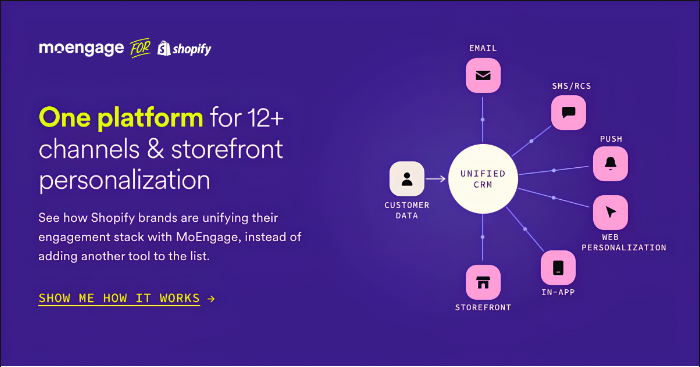
MoEngage is an agentic customer engagement platform with 16+ channels, including email, SMS, push, WhatsApp, in-app, web personalization, and on-site messaging, in one place, plus AI agents that help build and run the work. Instead of stitching together a tool for each channel, you plan one customer journey and let it follow the customer wherever they go.
For example, a shopper looks at a jacket on your site, ignores your email, then opens your app. MoEngage treats all of that as one person, so your next message reflects what they actually did, not what one channel happened to catch.
On the Shopify side, MoEngage has a native Shopify integration that connects your store without custom code. It tracks standard Shopify events automatically, syncs your existing customers and order history, and syncs your product catalog so recommendations use real inventory. It merges profiles using identifiers like Shopify ID, email, and phone number, and it carries over each shopper’s email, SMS, and WhatsApp opt-in status from Shopify.
On the AI side, MoEngage’s Merlin AI native agents can draft campaigns, build segments, check campaigns for errors before you send, and translate content, which matters when your team is small, and your to-do list isn’t.
For instance, Stadium Goods, the New York sneaker and streetwear marketplace, runs a custom-built inventory system that’s tightly coupled to Shopify. Its previous CEP kept breaking on catalog sync, and back-in-stock alerts depended on manual workarounds. After switching to MoEngage’s native Shopify integration, its triggered revenue nearly doubled year over year, its welcome email series grew roughly 10x, and price-drop emails grew by more than half. Syncing MoEngage audiences to Google and Meta also helped its international paid media revenue more than triple.
Want to see how it all fits together? This short video walks through MoEngage for Shopify.
In the video, MoEngage walks through the problems fast-growing Shopify brands run into, like disjointed tools and slow, inconsistent communication. It then shows how MoEngage brings more than 16 customer touchpoints into one user engagement platform. You’ll also see real-time data sync, agents that handle repetitive tasks, one customer view across online and offline touchpoints, and dedicated implementation support.
Best fit: Mid-market and enterprise Ecommerce brands that need customer engagement for retention, personalization, and coordinated omnichannel journeys.
Potential limitation: Ecommerce brands looking only for basic email newsletters may find MoEngage more capable than they currently need.
2. Klaviyo: Best for Email and SMS Automation on Shopify
Klaviyo is the default pick for a lot of Shopify stores, and for good reason. Setup is fast, the Shopify connection is deep, and email and SMS work well together. Product catalog sync keeps out-of-stock items out of your emails, discount codes can be generated and refilled automatically, and AI tools let you describe a segment in plain English and get it built. Marketers also like send-time optimization, which times each email to when that person tends to open.
The friction shows up as you grow. Klaviyo pricing is tied to your profile count, so your bill climbs with your list, and many teams end up running “sunset” flows just to clear out inactive profiles and keep costs down. SMS runs on a credit system that some brands find pricey enough to move texting to another vendor.
Buyers also tell us that flows and segment logic get tricky fast, and that support has moved toward tickets rather than a named contact. Advanced data features, like its customer data platform, can come as paid add-ons.
That’s usually the moment when marketers start browsing Klaviyo alternatives for Shopify and other Ecommerce brands.
You could also compare MoEngage vs. Klaviyo to understand where exactly the two CEPs differ when it comes to Ecommerce customer engagement and marketing automation.
Best fit: Shopify and Ecommerce brands that want fast-to-launch email and SMS automation.
Potential limitation: It may not be the best fit for brands that need extensive mobile app engagement, advanced enterprise governance, or complex cross-channel decisioning.
3. HubSpot: Best for Ecommerce CRM-Led Integration Across Marketing, Sales, and Service
HubSpot is a CRM first, with marketing, sales, and service tools sitting on top. That makes it a good fit when your customer relationships are complex: wholesale accounts, B2B buyers alongside shoppers, or a service team that needs to see every marketing touch.
For Shopify, HubSpot offers a Shopify data sync app that brings customers, orders, and products into HubSpot, and you can blend that data with the rest of your records in HubSpot’s data tools. You can trigger Shopify automated email workflows from that data, including abandoned checkout follow-ups.
Reviewers on HubSpot’s marketplace note a few gaps: the sync tracks abandoned checkouts rather than abandoned carts, some custom fields don’t come across, and syncs can lag at times. Third-party apps such as Unific fill some of those gaps, including abandoned cart and variant-level product data, but they add another vendor and another line item.
The trade-off is focus. HubSpot was built around relationships and leads, and marketers we’ve talked to describe it as strong for managing relationships but less natural for high-volume consumer shopping behavior. If your priority is one record for sales, service, and marketing, it’s a good pick. If your priority is real-time, behavior-based messaging across many channels, compare it carefully.
Best fit: Ecommerce companies with complex customer relationships or teams that need marketing, sales, and service in one system.
Potential limitation: Ecommerce lifecycle marketing may require additional configuration and integrations.
4. ActiveCampaign: Best for Budget-Friendly, Multi-Step Ecommerce Automation
ActiveCampaign sits between a simple email tool and a full enterprise suite. It combines Ecommerce marketing automation, a built-in CRM, and messaging across email, SMS, and WhatsApp, and its automation builder is known for handling multi-step logic without much fuss.
Its Shopify tie-in is a real strength. The integration syncs orders, products, customers, and abandoned carts both ways, and you can use that data to trigger automations, segment by purchase behavior, and show the exact abandoned product inside a Shopify personalized email. Higher tiers add a product catalog, coupon blocks, an Ecommerce dashboard, and a marketing revenue report, with predictive sending and conditional content on the Pro plan, which is also where the Shopify Plus integration appears.
Two details to know before you commit. Abandoned cart data only syncs once a shopper reaches the shipping step of checkout, and it can’t import historical abandoned carts. Draft orders also don’t sync. Pricing is tiered by contacts, so model your costs at your real list size. For lean teams that want strong automation and a built-in CRM without an enterprise price tag, it’s a smart shortlist addition.
Best fit: Lean to mid-market Ecommerce teams that want multi-step automation, a built-in CRM, and email, SMS, and WhatsApp without an enterprise price tag.
Potential limitation: Abandoned cart data reaches the platform late, and the Shopify Plus integration sits on the Pro tier and above. Also, its core channels don’t include mobile or web push, so app-first brands will need another tool.
5. Attentive: Best for SMS and Conversational Commerce Engagement
Attentive started with SMS and later added email, so it’s strongest for brands where texting is the main event. Shopify teams like how simple it is to use, and marketers who’ve run both tools often say its text messaging feels more mature than Klaviyo’s, which grew out of email.
It also covers sign-up pop-ups, which helps you grow your text list from the first visit. Where it falls short is breadth. It isn’t a full all-channel platform, so many brands run it next to a Shopify email marketing tool, and that’s where the headaches start. Buyers tell us that subscriber counts don’t always match between the two systems, and that each tool wants to be the center of the stack.
If texting drives most of your revenue and you’re happy with your email setup, Attentive is a clean choice. If you’re trying to cut tools, it adds one. That’s where many Ecommerce marketing teams compare MoEngage vs. Attentive.
Best fit: Shopify and consumer Ecommerce brands where SMS is a primary engagement and revenue channel.
Potential limitation: Brands looking for a broad orchestration layer across mobile apps, in-app messaging, web personalization, and complex enterprise data may need a more comprehensive platform.
6. SAP Emarsys: Best for Multi-Brand, Multi-Region Engagement
SAP Emarsys, now part of SAP Engagement Cloud, is built for larger retailers running several brands or regions. A central team sets the rules and shared templates, and local teams adapt campaigns for their market, which saves you from running a separate account in every country.
Store and online data feed one customer view, loyalty tools sit inside the platform, and AI agents can plan and send campaigns once you set the goal. A wallet loyalty card can identify members in the store, and direct mail sits next to the digital channels.
If you manage a handful of storefronts across countries, that structure helps. For a single-brand Shopify team, it’s likely more than you need, and you’ll connect Shopify through its integrations rather than a Shopify-first app.
Best fit: Larger retailers and Ecommerce groups running several brands, regions, or both, with a central team that governs local campaigns and needs store and online data in one view.
Potential limitation: It’s heavier than what a single-brand Shopify team needs. Shopify connects through integrations rather than a Shopify-first app, and you should expect a longer implementation than with lighter tools.
7. Salesforce Marketing Cloud: Best for Ecommerce Marketing Teams Already Running on Salesforce
Salesforce Marketing Cloud, which Salesforce now ties to its Agentforce Marketing push, makes the most sense when the rest of your business already lives in Salesforce. Customer data, service, and marketing share one ecosystem, and AI agents can help build audiences, content, and campaigns, with a marketer approving before launch.
Here’s the catch. Salesforce’s own commerce product is Commerce Cloud, and Marketing Cloud doesn’t have a native Shopify connector. Ecommerce brands usually connect the two with third-party tools, which adds cost, setup time, and one more thing to maintain. Loyalty is also a separate Salesforce product with its own license. If you see these as dealbreakers, evaluating Salesforce Marketing Cloud alternatives can be a good option.
If you’re a large brand with Salesforce CRM, a technical team, and a long runway, it can work well. For everyone else, plan for a longer rollout and a bigger budget, and map your Shopify data flow before you sign.
Best fit: Large enterprises already invested in Salesforce products and infrastructure.
Potential limitation: Licensing, implementation, and administration can be expensive and complex for mid-market Ecommerce teams. Always read Salesforce Marketing Cloud reviews before adding it to your vendor shortlist.
How We Evaluated the Best Customer Engagement Platforms for Ecommerce
A platform can claim to be ‘omnichannel’ while only supporting email and/or SMS, as the best Shopify SMS apps do. That’s why we looked beyond channel checklists.
We evaluated each Ecommerce customer engagement platform across 6 criteria:
| Criterion | What we looked at |
| Channel coverage | Email, SMS, push, in-app, web, WhatsApp, chat, and other relevant channels |
| Behavioral data | Browsing, cart, purchase, product, loyalty, and customer service events |
| Journey orchestration | Whether marketers can coordinate multiple messages and channels in one journey |
| AI capabilities | Whether AI assists with content, segmentation, recommendations, and optimization, or runs campaigns end to end |
| Ecommerce integrations | Shopify, Shopify Plus, BigCommerce, other commerce platforms, customer data platforms, and analytics tools |
| Enterprise readiness | Scale, governance, permissions, regional operations, reporting, and data management |
Those 6 criteria sort platforms that look alike on a feature page. To use them on your own shortlist, you’ll need a vendor checklist, and the right one depends on your size.
Ecommerce Customer Engagement Platform Features Checklist by Business Size
The right feature checklist changes as your Ecommerce business grows.
A mid-market Ecommerce brand usually needs speed, usability, dependable integrations, and a manageable total cost.
An enterprise Ecommerce brand needs those things too. But it also needs governance, scale, regional controls, advanced data architecture, and operational resilience.
The following two checklists separate those priorities and help you in choosing a customer engagement platform for your Ecommerce brand.
What Features Should You Look For in an Ecommerce Customer Engagement Platform for Your Mid-Market Brand in 2027?
A digital customer engagement platform for Ecommerce should make it easy to collect customer signals, create audiences, coordinate campaigns, and measure business outcomes, ideally without a developer on call.
| Ecommerce CEP capability | Questions to ask vendors | Why it matters |
| Shopify integration | Does the integration sync orders, products, customers, carts, and browsing events? | Campaigns depend on timely and accurate Ecommerce data. |
| Real-time events | How quickly do events enter the platform? | Delayed data creates irrelevant messages. |
| Customer profiles | Can the platform unify anonymous and known behavior? | You need continuity before and after a shopper identifies themselves. |
| Segmentation | Can marketers build behavioral, transactional, predictive, and value-based segments? | Basic demographic segments aren’t enough for modern retention marketing. |
| Journey orchestration | Can a journey coordinate email, SMS, push, web, and in-app messaging? | Customers don’t experience your Ecommerce brand one channel at a time. |
| Suppression rules | Can campaigns stop automatically after a purchase or support issue? | Relevance is often about knowing what not to send. |
| Personalization | Can content, products, offers, and timing change by customer? | Personalization should go beyond adding a first name. |
| AI capabilities | Does AI create suggestions, or can it execute approved workflows? | This reveals whether the platform is truly agentic or simply an assistant. |
| Ease of use | Can a marketer build and launch a journey without a developer? | Lean Ecommerce teams can’t wait in an engineering queue. |
| Experimentation | Can teams test content, timing, channel, and journey paths? | Optimization requires more than measuring opens and clicks. |
| Reporting | Can you connect engagement to revenue, repeat purchases, and lifetime value? | Marketing activity should tie back to business outcomes. |
| Pricing and support | What will we pay as our list grows, and who helps us when we’re stuck? | Surprise overages and ticket-only support hurt growing Ecommerce teams most. |
| Data privacy | Does the platform support consent, preferences, and deletion workflows? | Compliance and customer trust are non-negotiable. |
Start with data. Your Ecommerce customer engagement platform should pull in orders, carts, and browsing activity from your store in near real time, and it should merge a shopper’s anonymous visits with their profile once they sign up. If data shows up late, your abandoned cart email (that you might create with a cart abandonment email template) lands after they’ve already bought.
Next, check channels. You want email, SMS, push, WhatsApp, in-app, and on-site messages in one campaign builder, not five. Then look for AI that does real work, such as building segments or drafting campaigns from a plain-English request, instead of only suggesting the best email subject lines to boost open rates.
Finally, check pricing and support, because the sticker price rarely tells the whole story.
If you outgrow this list, the enterprise version below is where you’ll head next.
Ecommerce Customer Engagement Platform Features Checklist for an Enterprise Brand in 2027
Enterprise Ecommerce buyers still need everything above, but the stakes and the number of stakeholders are higher.
The questions below focus on what breaks at scale: data volume, brand and region complexity, security reviews, and the cost of an outage during peak season.
| Enterprise Ecommerce CEP capability | Questions to ask vendors | Why it matters |
| Scale and speed | How many events and messages can you process during a peak like Black Friday, and can you share a customer example? | A platform that’s fine at 100,000 profiles can stall at 10 million |
| Data architecture | Can you read from and write to our data warehouse and CDP, or must all data live in your system? | Copying data between systems creates drift and extra cost |
| Identity resolution | How do you match anonymous and known profiles across brands, regions, and devices? | One shopper shouldn’t look like three people |
| Multi-brand, multi-region setup | Can a central team manage shared templates while local teams adapt content, languages, and consent rules? | You don’t want a separate account for every market |
| Governance | What roles, approval steps, audit logs, and single sign-on options exist? | Control reduces risk without slowing every campaign |
| Security and compliance | Which security certifications do you hold, and how do you handle data residency, consent, and deletion requests? | Security reviews can stall a deal for months |
| Reliability and support | What uptime do you commit to in writing, and will we have a named customer success manager? | Outages in peak season are expensive |
| Deliverability | Do we get dedicated sending infrastructure, and who handles warm-up and monitoring? | Inbox placement drives email revenue |
| Testing environments | Is there a sandbox to test journeys before they go live? | A mistake at enterprise scale reaches millions of people |
| Measurement | Can we run holdout tests to measure true incremental revenue across channels? | Every channel claims credit unless you test |
| AI controls | Can we set rules, require approvals, and review an audit trail of what the AI did? | Autonomy without guardrails is a brand risk |
| Integrations | Are there native connections to our CRM, order management system, point of sale, and analytics tools? | Custom integrations add cost and break more often |
| Implementation and migration | Who does the migration work, and how will live campaigns stay safe during the move? | Revenue keeps flowing while you switch |
| Contract terms | Can pricing flex with seasonal volume, and what are the renewal and exit terms? | Flexibility matters when volume spikes twice a year |
If a vendor can’t answer these questions cleanly, that’s useful information too.
Once you know what to ask, the next question is how Shopify specifically changes the picture.
Customer Engagement on Ecommerce Platforms: What Shopify Brands Need to Check
Most Ecommerce customer engagement platforms say that they ‘integrate with Shopify’. That phrase covers everything from a one-click app to a third-party connector your developer has to babysit. If you’ve ever been told something was ‘basically the same’, and it wasn’t, you know why this matters.
Start with how the connection works. Some platforms have a native Shopify connection that syncs orders, customers, and products out of the box. Others rely on outside connectors. Salesforce Marketing Cloud, for example, doesn’t offer a native Shopify connector, so brands typically use third-party tools such as RudderStack or Webkul’s connector to pass data through.
Next, check how much cart data you actually get. ActiveCampaign, for instance, only syncs a Shopify abandoned cart once the shopper reaches the shipping step of checkout, and it can’t pull in historical abandoned carts. HubSpot’s Shopify sync app tracks abandoned checkouts rather than carts, based on user reviews on its marketplace. Neither is a dealbreaker, but both change how early you can reach a shopper.
Then, look at consent and catalog sync. Your Ecommerce customer engagement platform should respect each shopper’s email, SMS, and WhatsApp opt-in status as it exists in Shopify, and it should read your product catalog so product recommendations don’t point to sold-out items.
Finally, if you’re on Shopify Plus, confirm it’s supported on your pricing tier. ActiveCampaign, for example, lists its Shopify Plus integration on its Pro plan and above.
Here’s that list in a format you can take into vendor calls.
| Shopify check | What to ask the Ecommerce CEP vendor | Why it matters |
| Connection type | Is there a native Shopify app or only a connector? | Connectors add cost and break more often |
| Cart data | At what point does an abandoned cart reach your platform? | Later data means later recovery messages |
| Consent sync | Does Shopify opt-in status carry over for email, SMS, and WhatsApp? | Protects you from messaging people who opted out |
| Catalog sync | Does the platform read live Shopify product data? | Keeps recommendations in stock |
| Shopify Plus | Is Plus supported on the plan I’m quoted? | Some features sit on higher tiers |
| In-store data | Can point-of-sale purchases reach the customer profile? | Stops “buy this coat” emails after an in-store purchase |
If a vendor can’t answer these cleanly, you’ve learned something. Next, let’s turn them into a fuller Ecommerce CEP buying checklist.
Best Ecommerce Customer Engagement Platforms by Use Case
Different Ecommerce marketing teams need different capabilities. The table below maps common business goals to the Ecommerce CEPs most closely aligned with them.
| Ecommerce engagement use case | Best-fit Ecommerce CEP | Why |
| Omnichannel retention and lifecycle journeys | MoEngage | Combines behavioral data, AI-assisted execution, and coordinated engagement across multiple channels. |
| Shopify email and SMS automation | Klaviyo | Offers deep Shopify connectivity and widely used ecommerce lifecycle workflows. |
| CRM-led marketing, sales, and service engagement | HubSpot | Connects marketing activity with CRM, sales, and customer service records. |
| Budget-friendly multi-step automation | ActiveCampaign | Provides visual automation, CRM functionality, and ecommerce workflows at a lower level of complexity. |
| SMS marketing and conversational commerce | Attentive | Focuses on SMS list growth, messaging automation, and two-way commerce conversations. |
| Multi-brand and multi-region retail engagement | SAP Emarsys | Supports centralized governance and localized execution across markets and brands. |
| Salesforce-based enterprise engagement | Salesforce Marketing Cloud | Fits organizations already using Salesforce customer, commerce, and service products. |
What’s the Best Customer Engagement Platform for Retail Ecommerce to Improve Repeat Purchase and LTV?
If your goal is more second and third orders, how you use the platform matters as much as which one you pick. Still, a few things separate tools that move lifetime value (LTV) from tools that just send more messages.
Look for strong “what did they buy, and when” segmentation so you can nudge someone right as they’re due to reorder. Look for journeys that stop automatically after a purchase, so you’re not chasing a customer who already converted. And look for cross-channel logic that picks the best channel per person, so one shopper doesn’t get a Shopify post-purchase email, a text, and a push in the same hour.
Here’s a quick way to size the prize. Say you have 100,000 customers, and better targeting lifts your repeat purchase rate by 2 points. That’s 2,000 extra buyers. At a $75 average order, that’s $150,000 in added revenue without buying a single new ad click. Run the math with your own order value, and ask every vendor for a similar brand that saw real results.
For this goal, platforms with broad channel coverage and AI-built journeys, like MoEngage and Klaviyo, give you the most room to grow. ActiveCampaign works if your volume is modest and your needs are mostly email-led. Next, let’s look at how these platforms play with the CRM you already have.
What are the Best Customer Engagement Platforms for Ecommerce With a CRM Integration?
CRM integration is where plenty of great demos quietly fall apart. Your CRM knows who the customer is, and your Ecommerce engagement platform knows what they did. If the two don’t share notes, sales, service, and marketing end up working from different stories.
Ask each vendor 3 things.
- First, does data flow both ways, or only one?
- Second, how often does it sync: live, hourly, or overnight?
- Third, who fixes it when it breaks?
HubSpot and Salesforce Marketing Cloud have the tightest CRM ties because the CRM is the product. ActiveCampaign includes a built-in CRM for smaller Ecommerce marketing automation teams. MoEngage offers a native Salesforce CRM integration, while the others generally rely on connectors or data warehouses, so confirm yours is supported before you commit.
Next, let’s turn these questions into a fuller Ecommerce CEP vendor shortlist, depending on the size of your Ecommerce brand.
Best Ecommerce CEPs by Business Size
The best Ecommerce CEP for a mid-market brand is usually the one a small team can launch quickly and afford as the list grows. The best CEP for an enterprise Ecommerce brand is usually the one that scales across brands and regions with the right controls.
The table below summarizes our picks, and the sections after it explain the reasoning.
| Business size | Strong Ecommerce CEPs | Why they fit |
| Mid-market, Shopify-first | MoEngage, Klaviyo, ActiveCampaign | Fast Shopify setup, small-team friendly, room to add channels |
| Mid-market, SMS-led or CRM-led | Attentive, HubSpot | SMS depth, or one record across sales, service, and marketing |
| Enterprise, omnichannel, or multi-brand | MoEngage | Agentic, coordinated engagement across owned channels |
| Ecosystem-led | SAP Emarsys, Salesforce Marketing Cloud | Central governance, or deep fit with an existing SAP or Salesforce stack |
Think of it this way: mid-market winners are judged on how fast you get value, while enterprise winners are judged on how well they hold up under pressure. Let’s start with the mid-market.
What is the Best Customer Engagement Platform for a Mid-Market Ecommerce Brand?
For most mid-market Shopify brands, the best choice is either MoEngage or Klaviyo, depending on how many channels you plan to run. A mid-market team typically has a few marketers, a few channels, and no spare developer, so the customer engagement platform for Ecommerce needs to launch quickly and be simple to manage.
Klaviyo is the natural pick if email and SMS are your main channels. Its Shopify connection is deep, setup is fast, and plain-English segment building saves time.
MoEngage is the better Ecommerce CEP if you’re adding push, WhatsApp, in-app, web personalization, or on-site messaging, and don’t want to buy a new tool for each one. Its native Shopify integration needs no custom code, and its AI agents can draft campaigns and build segments, which helps a small team do the work of a bigger one. You can also start with one channel and add more over time.
ActiveCampaign suits budget-conscious teams that want multi-step automation and a built-in CRM, as long as late abandoned cart data and the lack of push aren’t dealbreakers. Attentive makes sense when SMS drives most of your revenue. HubSpot fits mid-market brands that also sell to wholesale or B2B buyers and need sales and service on the same record.
What is the Best Customer Engagement Platform for Enterprise Ecommerce?
For enterprise Ecommerce, the best customer engagement platform usually balances scale, data flexibility, omnichannel execution, governance, and ease of use.
MoEngage is a strong fit when your enterprise Ecommerce team wants agentic customer engagement for coordinated Ecommerce lifecycle campaigns, real-time personalization, and retention across owned channels.
Poshmark shows the scale involved. After migrating its mature email program from an internal tool, it now sends 1.5 billion emails a month on MoEngage, and flow versioning drove a lift of more than 30% in converting listings to sales.
What’s more, MoEngage connects to Shopify through a dedicated app and has a native Salesforce CRM integration. It also lets you choose which identifiers it uses to recognize a customer.
Salesforce Marketing Cloud is often a better omnichannel Ecommerce platform for organizations deeply embedded in the Salesforce ecosystem. Adobe Journey Optimizer can make sense for enterprises already using Adobe Experience Platform.
The right choice depends less on the number of features and more on how well the platform fits your existing data architecture and operating model.
How to Choose the Best Customer Engagement Platform for Ecommerce
Choosing an Ecommerce customer engagement platform gets easier when you start with the problem instead of the vendor.
If your main goal is Shopify email and SMS automation, Klaviyo may be the natural shortlist leader. If your priority is retention, personalization, and coordinated omnichannel customer journeys, MoEngage deserves a close look. If you want a broader CRM across marketing, sales, and service, HubSpot or Salesforce may make more sense.
1. Start with the Customer Journey You Need to Improve
Are customers abandoning carts? Buying once and disappearing? Ignoring your campaigns? Choosing the wrong products? Contacting support repeatedly? The platform should solve a measurable Ecommerce customer journey problem.
Pick one or two journeys, write down today’s number (cart recovery rate, 90-day repeat purchase rate, or revenue per email), and use them as your yardstick. Then ask each finalist to build that exact journey during the demo, using a sample of your real data. A canned demo with perfect fake data proves nothing.
2. Map the Channels Customers Actually Use
Don’t buy a platform because it supports 12 channels if your customers respond to 3. Look at your current data. Do your customers engage with email, SMS, push notifications, WhatsApp, mobile apps, web personalization, or conversational messaging? That’s how an omnichannel Ecommerce strategy works.
Check which channels drive revenue today, how many customers have opted in to each, and which one you’ll likely add in the next 12 months. Then make sure the Ecommerce customer engagement platform can add that channel without a new contract or a new tool.
Also ask how it handles channel choice and frequency caps, so one customer doesn’t get the same offer on 4 channels in an hour.
3. Evaluate the Data Before Evaluating the AI
AI can’t fix missing, delayed, or unreliable customer data. Ask whether the platform can receive product views, searches, cart events, purchases, refunds, customer service events, loyalty activity, subscription events, campaign engagement, and mobile and web behavior. The better the data foundation, the better your Ecommerce personalization and automation will be.
Then, test it. Ask how long a Shopify event takes to show up on a customer profile, how the platform merges a shopper’s anonymous browsing with their known profile, and whether the AI works from your data or from generic patterns.
If the answers are vague, the AI features are probably more demo than reality.
4. Calculate the Real Cost at Scale
Pricing may depend on contacts, monthly tracked users, messages, seats, events, channels, or revenue.
Model your expected cost using your actual list size, order volume, traffic, message volume, and number of users. Entry-level pricing rarely tells the whole story.
5. Ask How Much Work Your Marketing Team Will Still Need to Do
A platform can technically support omnichannel engagement while still requiring your team to manually build every campaign.
Ask vendors whether AI can create a journey from a business goal, recommend the next best action, adapt campaigns automatically, suppress irrelevant messages, and execute approved workflows.
That’s where Ecommerce customer engagement platforms that are agentic can create a real advantage.
A simple test: ask a vendor how many hours it takes one marketer to launch a new multi-channel journey, and have them show you the clicks. If the answer is “A few days and a developer,” a lean team will feel the brunt every week.
6. Check the Support and Customer Success Model
Support is one of the most common reasons brands leave a platform, and it’s rarely discussed in demos. Merchants tell us they’ve gone from a named account manager to a ticket queue, and that slow fixes pile up when something breaks during a promotion.
Ask whether you’ll get a named customer success manager, what response times are in writing, and who helps with strategy, not just bugs.
The best vendors proactively bring ideas, like “Other brands are doing this, and here’s the revenue case,” instead of waiting for you to file a ticket. Get the support model in the contract, not just in the sales deck.
7. Test Deliverability and Sending Setup
The best campaign in the world is worthless if it lands in spam. Ask how the Ecommerce customer engagement platform protects your email sender reputation: whether you get dedicated or shared sending infrastructure, how it helps you authenticate your domain, and what the plan is to ease new sending volume in gradually.
Some brands have left platforms because of shared infrastructure problems, so this isn’t a small question.
For SMS and WhatsApp, ask how the platform handles opt-in tracking, quiet hours, and carrier or Meta rules. A good vendor will answer in plain language and show you where to monitor it.
8. Pressure-Test With References and a Pilot
Ask for two or three references that look like your Ecommerce brand: similar size, similar platform, and similar channels. Ask them what broke in the first 90 days, how fast support responded, and what they wish they’d known. If a vendor can’t name a Shopify or other Ecommerce reference at your scale, that’s worth noting.
Then, if you can, run a pilot on one channel or one customer segment, with a holdout group that doesn’t receive the messages. That’s the only clean way to measure whether the platform provides personalized Ecommerce customer experiences and adds real revenue, instead of taking credit for purchases that would have happened anyway.
Finally, score your finalists with a simple weighted scorecard like the one below.
Ecommerce Customer Engagement Platform Vendor Evaluation Scorecard
| Evaluation area | Mid-market weight | Enterprise weight | What a strong answer looks like |
| Shopify data and speed | 25% | 15% | Native app, near real-time events, clean consent sync |
| Channels and orchestration | 20% | 20% | One journey across all channels you use or plan to use |
| Ease of use and AI | 20% | 10% | Marketers launch journeys without a developer |
| Governance, security, and scale | 5% | 25% | Roles, approvals, audit logs, proven peak performance |
| Total cost and contract terms | 15% | 10% | Clear quote at 1x, 2x, and peak volume |
| Support and success model | 10% | 10% | Named contact and written response times |
| References and pilot results | 5% | 10% | Comparable brands and a measurable holdout test |
Treat these weights as a starting point, and adjust them to your priorities. A scorecard keeps the loudest voice in the room from picking the winner, and it gives you a paper trail when finance asks why you chose what you chose.
Even a perfect score doesn’t tell you what you’ll actually pay, so let’s look at how platforms charge.
Ecommerce Customer Engagement Platform Pricing: How Vendors Charge in 2027 and What to Watch Out For
Ecommerce customer engagement platforms charge in a few common ways: by the number of profiles or contacts, by monthly tracked users, by messages or credits, or through a negotiated enterprise contract. Which model fits you best depends on how your list and traffic behave.
The table below shows how each one tends to play out.
| Pricing model | How it works | Where you’ll see it | What to watch for |
| Profile-based | You pay for the number of profiles in your account, active or not | Klaviyo | Your bill grows with your list, which pushes teams to purge inactive profiles |
| Contact-tiered | You pay by contact tier, with email sending limits tied to each tier | ActiveCampaign, HubSpot | Features and Shopify Plus support may sit on higher tiers |
| Monthly tracked users | You pay for customers who engage with your campaigns in a month, across channels | MoEngage | Compare your active base to your total list to see the real cost |
| Message- or credit-based | You pay per text or per message credit, often on top of a base plan | SMS tools, including Klaviyo and Attentive SMS | Credits can add up fast during promotions |
| Negotiated enterprise contract | Custom quote based on modules, volume, and services | SAP Emarsys, Salesforce Marketing Cloud | Add-ons like loyalty, data, and services can change the total |
Hidden costs matter as much as the base price. Ask about onboarding fees, extra seats, separate modules for loyalty or data, overage charges, and any developer time you’ll need for integrations. Also factor in the cost of the tools you could retire if the new platform replaces them.
To judge whether a platform pays for itself, work backward.
Say your net annual cost is $45,000 and your profit margin is 40%. You need about $112,500 in revenue to break even ($45,000 divided by 0.40). If a vendor can show a similar brand that cleared that bar comfortably, you’re looking at a safer bet. If they can’t, keep asking.
Price is only half the story, because getting onto a new platform has a cost of its own. So let’s talk about how to switch without losing revenue.
How to Switch Customer Engagement Platforms for Ecommerce Without Losing Revenue
Switching platforms is a lot like moving apartments: it’s worth it, but only if you plan the move and don’t do it the week before the holidays. Most brands stay on a tool longer than they’d like because migration feels risky, and that’s a fair concern. A phased customer engagement platform migration strategy cuts most of the risk.
First, check your contract. Look at your renewal date and notice period before you start a serious evaluation, because many contracts renew automatically, and some brands are locked in for a year or two. Then pick your move window. Avoid the months before Black Friday and Cyber Monday, since your email reputation and your team’s attention are both precious during peak season.
Next, don’t try to rebuild everything. Start with the flows that make the most money: welcome, browse and cart abandonment, post-purchase, win-back, and replenishment. Move your best performers first and retire low-performing flows instead of copying them over.
You can also keep your old platform running for one channel while you move another, which is a common way to lower risk for lean teams.
Consent and data deserve extra care. Export your profiles, purchase history, and suppression lists, and make sure each shopper’s opt-in status for email, SMS, and WhatsApp carries over correctly. Sending to someone who opted out can cost you more than any platform fee.
Finally, run both systems side by side for a short period, and ramp up email volume gradually so inbox providers learn to trust your new setup.
| Phase | What to do | Why it matters |
| Plan | Review contract dates, pick a move window outside peak season, and name an owner | Prevents rushed decisions and surprise renewals |
| Connect | Install the Shopify integration and confirm events, orders, and catalog are flowing | Bad data on day one creates bad messages for months |
| Migrate | Move profiles, purchase history, suppression lists, and consent status | Protects you from messaging people who opted out |
| Rebuild | Recreate your top revenue flows first, then retire the weak ones | Keeps revenue steady while you clean house |
| Run in parallel | Send from both platforms for a short overlap and ramp volume up slowly | Protects your email reputation |
| Cut over and measure | Turn off the old flows and compare results against your baseline | Confirms the move paid off |
Ask every vendor who does each phase: your team, their team, or a partner agency. A clear answer here predicts how smooth the move will be.
With the picks, priorities, costs, and switching plan covered, let’s tie it all together.
Best Ecommerce Customer Engagement Platforms: Which One Should You Pick in 2027?
The best customer engagement platforms for Ecommerce all share one trait: they make one shopper look like one person, no matter which channel that person uses. After that, the right pick comes down to your team and your goals.
If email and SMS cover you today and you want the fastest setup, Klaviyo is a fair pick. Lean teams that want strong automation and a built-in CRM should look at ActiveCampaign, while HubSpot suits brands whose sales, service, and marketing all need one record. Text-first brands can look at Attentive, and teams managing many brands, heavy data, or an existing Salesforce or SAP footprint should check SAP Emarsys or Salesforce Marketing Cloud first.
If you’re a Shopify brand that wants email, SMS, push, WhatsApp, and on-site experiences in one place, with AI helping a lean team do more, MoEngage is where we’d start.
Ready to see how it works on your Shopify store or Ecommerce brand with MoEngage? Book a demo, and we’ll walk through your data, your channels, and your goals together.