







Governance as Velocity: Why AI Guardrails Prevent Catastrophic CX Failures
In regulated sectors like healthcare, insurance, and banking, enterprise leaders often treat compliance and AI governance as administrative obstacles. Many assume strict operational guardrails slow innovation. However, confusing content generation with appropriate customer outreach leads directly to regulatory friction and broken trust. In complex service environments, governance is not a brake; it is the velocity layer that enables safe, real-time automation.
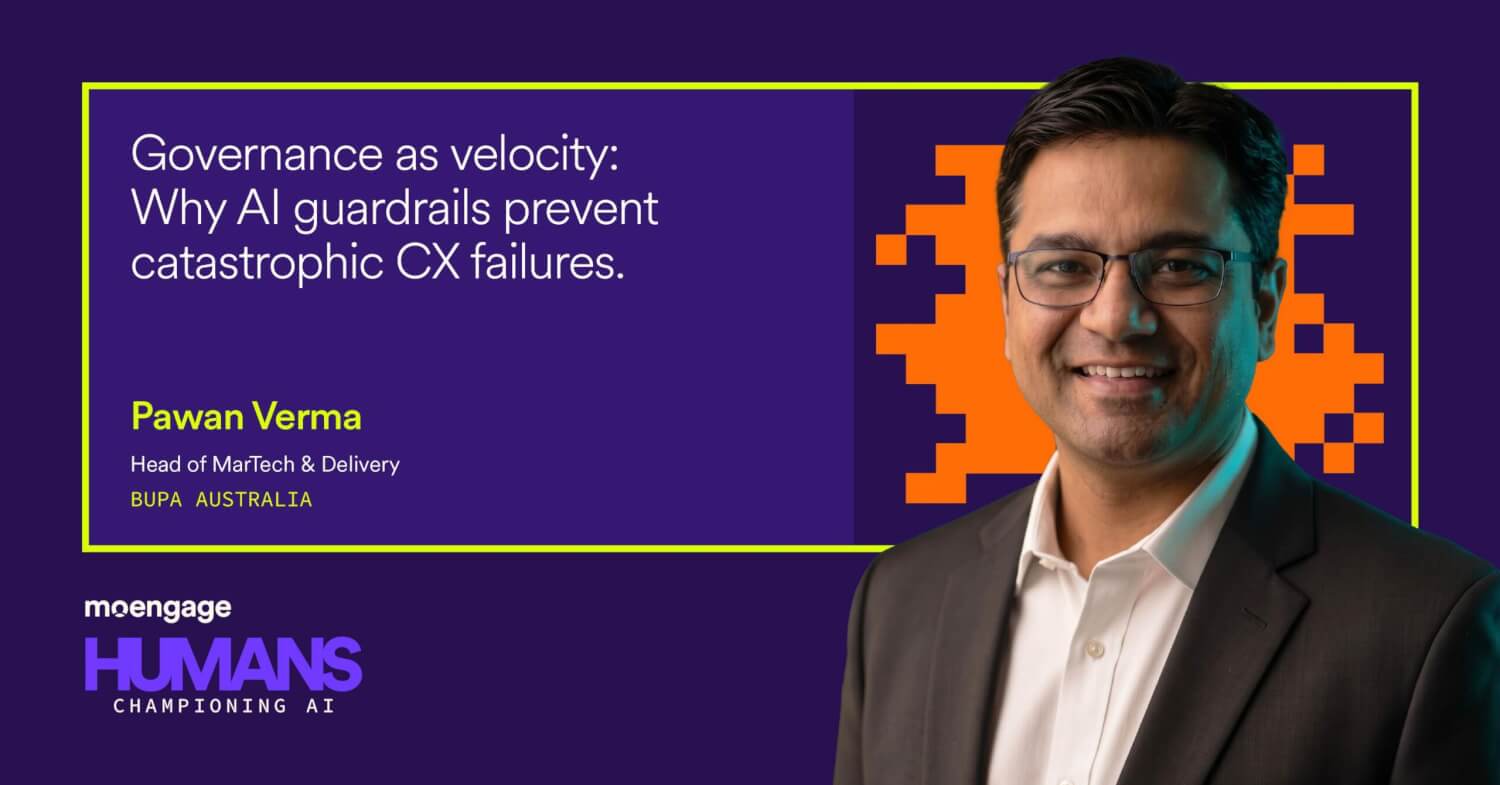
In our Humans Championing AI series, we spoke with Pawan Verma, Head of MarTech & Delivery at Bupa Australia. Pawan shares how healthcare and financial enterprises can build real-time suppression circuits, manage competing AI agents, and establish responsible human override systems.
Generative Copy vs. AI-Native Governance
MoEngage: Pawan, what separates basic Generative AI execution from true AI-native customer engagement in regulated industries?
Pawan Verma: Generative tools produce content on demand, but AI-native engagement sets the operational guardrails around the interaction. It determines whether to contact a customer at all, on which channel, when, and under what specific emotional or regulatory conditions.
In healthcare and financial services, generating email copy is trivial. The complex challenge is evaluating live context before sending that copy. If an automated model sends a promotional upsell message while a customer is dealing with a critical claim or service hardship, the brand experience fails completely. AI-native engagement provides the real-time context layer that prevents those operational misfires.
The Catastrophic System Misfire: A Real-World Scenario
MoEngage: Can you walk us through how an automated campaign can pass every internal marketing KPI and still cause a catastrophic customer experience?
Pawan Verma: Consider a propensity model that accurately identifies a health insurance customer with a high statistical likelihood to upgrade their coverage. The automated engine triggers a personalized, on-brand promotional notification.
What the marketing system does not know, because the signal lives isolated in a clinical or claims support database, is that the customer submitted a claim three days earlier for a critical medical diagnosis. The commercial upgrade offer lands in their inbox the morning after a distressing consultation.
Technically, the marketing system performed flawlessly: the target was accurate, the channel was active, and the offer was personalized. Yet the customer experience was devastating. The system optimized for a commercial conversion score while remaining blind to the human context that mattered most.
Governance as Velocity: Advanced Brakes for Faster Innovation
MoEngage: Many business leaders argue that strict compliance checks and governance committees slow down transformation. How do you address that concern?
Pawan Verma: That argument is inside out. High-performance race cars do not have advanced carbon brakes so they can drive slowly; they have them so they can take tight turns at high speeds safely.
Governance is your enterprise velocity layer. When clear operational guardrails, suppression rules, and real-time auditability are hardcoded into your decisioning architecture, your teams can deploy autonomous agents with total confidence. If you build for speed first without guardrails, you spend years managing public relations disasters and regulatory reviews. Build guardrails first, and operational speed follows naturally.
Multi-Agent Arbitration and The Asymmetric Human Override
MoEngage: As enterprises deploy specialized AI agents for cross-sell, retention, and support, how do you prevent those agents from competing for the same customer’s attention?
Pawan Verma: Organizations must deploy a centralized Arbitration Layer above individual domain agents. This layer operates on three core principles:
- Shared Customer Context: Every specialized agent acts on an identical, real-time enterprise profile rather than isolated channel data.
- Arbitration Logic: Commercial conversion value is continuously balanced against customer sentiment, recent service friction, and communication fatigue.
- Asymmetric Human Override: Any team member across customer care, legal, or marketing can pause an automated journey or audience segment immediately without prior committee approval. Review and justification happen after the pause. Making automated campaigns easy to stop and harder to start is a vital design choice in responsible governance.
Redefining the MarTech Delivery Profile for 2026
MoEngage: How must the skills within MarTech and delivery teams evolve as AI assumes greater operational autonomy?
Pawan Verma: By 2026, MarTech and delivery professionals must move beyond platform configuration and basic ticket management. Teams need specialists who understand data integration, API architecture, regulatory compliance, and risk management.
The ideal MarTech hire can evaluate how data flows between clinical or operational databases and customer engagement platforms. They must possess the technical depth to audit decisioning logic and the business acumen to recognize when an automated workflow risks breaching customer trust.
Key Takeaways for Healthcare and Financial Executives
- Build Real-Time Suppression: Connect clinical, service, and hardship databases to engagement engines to pause marketing during sensitive events.
- View Governance as Speed: Implement automated guardrails first so teams can deploy new engagement workflows without manual sign-off delays.
- Deploy Central Arbitration: Establish an overarching arbitration layer to resolve conflicts between competing retention and acquisition agents.
- Enable Asymmetric Human Override: Let any care or compliance team member instantly pause automated outreach when risk is detected.