




8 Best Klaviyo Alternatives Compared (2026): Features, Shopify Fit, and Pricing
The best Klaviyo alternatives for Shopify brands in 2026 are MoEngage, Brevo, Drip, and Attentive for SMS-first programs. ActiveCampaign, HubSpot, Omnisend, and Mailchimp round out the list for automation, CRM, and simple email.
With that being said, the best platform depends on your business size, contact volume, Shopify setup, channel mix, automation complexity, analytics requirements, pricing model, and level of support needed.
This guide compares 8 marketing automation and customer engagement platforms by channels, segmentation, analytics, support, and scalability, so you can build a shortlist fast.
Quick Verdict: Best Klaviyo Alternatives by Business Needs
- Best for enterprise Shopify brands needing omnichannel customer engagement at scale: MoEngage
- Best for Ecommerce brands with large contact lists and lower send volume: Brevo
- Best for behavior-based Ecommerce segmentation and revenue-based testing: Drip
- Best for Shopify brands needing advanced automation and CRM: ActiveCampaign
- Best for Ecommerce brands connecting marketing, sales, service, and CRM data: HubSpot
- Best for Shopify brands with SMS-led customer acquisition and retention: Attentive
- Best for small Shopify stores needing affordable email marketing and basic automation: Mailchimp
- Best for small Ecommerce brands wanting a close Klaviyo replacement: Omnisend

Why are Shopify and Ecommerce Brands Looking for Alternatives to Klaviyo?
Klaviyo remains one of the strongest Ecommerce marketing automation platforms for Shopify brands. Its customer profiles, event tracking, segmentation, and revenue attribution are genuinely useful.
So why are Shopify brands still evaluating Klaviyo alternatives?
Usually, the issue isn’t that Klaviyo stops working. It’s that the platform no longer matches the brand’s growth stage, channel strategy, pricing expectations, or operating model. A small Shopify store may only need newsletters and a few core flows. A large consumer brand may need much more to get their Shopify conversion rate optimization right.
1. Klaviyo Pricing Becomes Difficult to Manage at Scale
Klaviyo bills on active profiles, so every emailable contact counts toward your plan, whether they’ve opened a message this year or not. As your list grows, the bill grows with it, even when revenue doesn’t.
That’s the pattern behind most complaints about Klaviyo pricing. A VP of Ecommerce at a beauty brand told us it’s gotten really expensive without adding much new functionality. Ouch.
The right comparison point changes as your list grows, so here’s what to focus on at each size:
| List size | What to compare |
| Under 2,500 | Free plans, ease of use, core flows |
| Around 10,000 | Contact-based versus send-based pricing |
| 50,000+ | Total cost, deliverability, support, data infrastructure |
| 100,000+ | Enterprise scalability, usage-based pricing, performance, contract terms |
2. Klaviyo is Primarily Optimized for Email and SMS
Klaviyo was built email-first, with SMS added later. That’s a great fit until your customers start living elsewhere: in your app, on WhatsApp, or on your site.
Here’s the thing. Customers don’t think in channels. They think in moments. A shopper who ignores your email might respond instantly to a push notification.
When your platform treats each channel as a separate project, you end up guessing where each message belongs. During a conversation with us, a Shopify brand VP described juggling different systems depending on the answer they needed, and wished that they would all just talk to each other.
3. Core Capabilities are Sold as Add-Ons (CDP and Advanced Analytics)
Klaviyo’s customer data platform (CDP) and its deeper analytics, like CLV dashboards and Recency, Frequency, and Monetary Value (RFM) analysis, are paid extras.
That’s not unusual in software. But it changes the math when you’re comparing total cost.
A Shopify beauty brand VP told us that they skipped Klaviyo’s CDP because it’s a paid add-on and it’s expensive. Sound familiar?
4. Klaviyo’s Support and Onboarding May Not Match Enterprise Requirements
Support is the most repeated complaint in our interviews. Klaviyo handles most accounts through shared channels, and larger teams often want more than a help center and a ticket.
The feedback is blunt. A director of operations at a CPG portfolio company said they went a year and a half without access to a growth manager. A director of marketing said that since the IPO, Klaviyo’s customer service seems to have dropped off the face of the planet.
What these teams want isn’t just faster replies. It’s a partner who spots gaps, suggests next steps, and knows their business. That’s a different job than answering tickets.
5. Klaviyo’s Shopify Integration is Strong, But Not Always Sufficient
Let’s give credit where it’s due. Klaviyo’s Shopify integration is one of the best in the market. Orders, carts, and product views flow in cleanly, and catalog sync works well.
But ‘strong’ isn’t the same as ‘sufficient’. Once your data lives in more places than Shopify, the picture gets messy. Retail POS data, app activity, and other tools don’t always sync without developer help.
A Shopify merchant told us that customer segmentation analysis in Shopify is brutal, so they build segments in Klaviyo, then use yet another system for different answers. Others noted that their email and SMS subscriber lists never quite matched across tools.
What Should You Look For in a Klaviyo Alternative?
Picking a new platform isn’t about finding the longest feature list. It’s about finding the one that won’t force you to switch again in 2 years.
So before you book a single demo, here’s what to test for when evaluating Klaviyo alternatives for Shopify stores. Use these 7 criteria to build your scorecard, and you’ll spot the weak fits fast.
| Criteria | The question to ask |
| Shopify and Ecommerce integration depth | Does store data sync in real time, and which events come through? |
| Cross-channel orchestration | Can one journey coordinate every channel without duplicate messages? |
| Segmentation, personalization, and predictive analytics | Do segments update as customers act? |
| Automation and workflow depth | Can you rebuild your most complex flow without custom code? |
| Analytics, attribution, and experimentation | Can you see the full journey and test for true lift? |
| Pricing scalability | What happens to your bill if your list doubles or shrinks? |
| Migration, deliverability, and support | Who helps you move, and who picks up when something breaks? |
Before switching, evaluate the areas below. They’ll help you separate a genuine fit from a platform that only looks good in a comparison table.
1. Shopify and Ecommerce Integration Depth
Look for a native Shopify integration that syncs orders, carts, products, and browsing events in real time. Then ask what happens beyond Shopify. Does the platform also accept data from your POS, app, or warehouse?
Don’t take a vendor’s word for it. A ‘Shopify integration’ can mean anything from a deep, event-level sync to a nightly import. So connect your actual store during the trial.
Check that out-of-stock items stay out of product recommendations, that discount codes carry through, and that custom events and metafields arrive intact. If a platform can’t handle your real data, it won’t handle your real campaigns.
2. Cross-Channel Orchestration
Supporting multiple channels isn’t the same as coordinating them.
A platform may offer email, SMS, WhatsApp, push, and in-app messaging as separate features. But can those channels work together inside one customer journey? That’s the question that matters.
Effective cross-channel customer journey orchestration should let your team decide which channel to use, when to use it, and what should happen next. For example, a customer might receive an email first, an SMS only if they don’t engage, and an in-app message after they return to your store or app.
Look for shared audience rules, unified customer profiles, channel sequencing, frequency controls, and conversion-based suppression. Otherwise, customers may receive several messages about the same offer from different systems.
A true omnichannel customer journey and engagement platform should also help you understand when not to send. Nobody wants to receive an email, text, push notification, and WhatsApp message for an abandoned cart!
3. Segmentation, Personalization, and Predictive Analytics
Basic lists and tags aren’t enough for sophisticated Ecommerce marketing.
A strong Klaviyo alternative should let you create dynamic segments using customer behavior, purchase history, product interest, engagement, geography, lifecycle stage, and predicted value. Those segments should update automatically as customer data changes.
Ecommerce personalization is the next layer. Can the platform show different products, offers, content, or messages to different customers? Can it personalize campaigns using real-time activity rather than yesterday’s data?
Be careful, though. ‘AI-powered’ can mean many things. Some platforms use AI to write subject lines. Others use predictive models to influence targeting and campaign decisions. Those capabilities aren’t interchangeable.
And what’s predictive, really? Churn risk, next purchase timing, and customer lifetime value are useful only if they feed directly into your campaigns. A customer engagement score that sits in a dashboard won’t earn you a dime.
4. Marketing Automation and Workflow Depth
A visual customer journey mapping tool or workflow builder is useful, but the real test is whether your team can build the journeys it needs without custom development.
Before switching, recreate your most important Ecommerce customer journeys in the Klaviyo alternative. Start with a welcome series, abandoned-cart flow, post-purchase journey, browse-abandonment campaign, and win-back sequence.
Then test the details:
- Can one workflow respond to multiple events?
- Does it support branching and conditional logic?
- Can customers exit when they purchase?
- Can the journey switch between channels?
- Can you add delays, goals, and frequency limits?
- Can marketers test different paths?
- Can a workflow use product, order, and engagement data?
- Can teams preview and troubleshoot the journey before launch?
A platform that handles simple Shopify automated emails like welcome emails may not support a complex replenishment or cross-sell strategy. Don’t discover that after migration. Test first!
5. Analytics, Attribution, and Experimentation
Campaign reporting should help you make decisions, not just produce attractive charts.
At minimum, evaluate whether the platform can connect campaigns and automated customer journeys to meaningful outcomes. For Ecommerce and Shopify brands, that usually means revenue, conversions, repeat purchases, average order value, and customer lifetime value, not only opens and clicks.
Look for reporting across campaigns and automated flows, channels, customer segments, products and categories, conversion funnels, retention cohorts, customer journeys, and revenue and profitability.
Attribution also deserves careful attention. How does the platform define a conversion? Does it use click-through, view-through, last-touch, first-touch, or custom attribution? Different models can produce very different performance numbers.
Finally, review the experimentation tools. Can your team test subject lines, content, offers, timing, workflow paths, and channels? Can it measure revenue per recipient or incremental lift? If testing is limited to opens and clicks, you may not get a complete picture of what improves business results.
6. Pricing Scalability
Forget the entry price for a moment. Ask what you’d pay if your list doubled, and what you’d pay if it shrank. Find out which features, channels, and credits cost extra, and how contracts handle overages. Get answers in writing.
A good rule of thumb: model your cost 24 months out, not just today. The platform that’s cheapest now can become the most expensive once your channels and audience grow.
This is where scenario planning helps. Compare the platform at your current size, expected growth size, and peak seasonal size. A tool that works well for 10,000 contacts may not be the right choice at 100,000 (more on that below).
You don’t need the lowest possible price. You need a pricing model that matches how your brand actually engages customers.
7. Migration, Deliverability, and Support
Switching platforms is a project, so ask how the vendor will help. Will they rebuild flows with you? Will they run in parallel while your old platform stays live? Remember that automations don’t transfer on their own, and SMS subscribers may need to re-confirm consent.
Next, protect your inbox placement. Ask about domain authentication, IP warm-up plans, and email deliverability monitoring, and don’t start a migration right before your busiest season.
Finally, look closely at support. Who’s your named contact? What are the response times in writing? Is onboarding included? A great platform with no one to call can still leave you stuck.
The best Klaviyo alternative for Shopify stores should reduce operational risk, not create another project your marketing team has to manage alone.
Top Klaviyo Alternatives for Shopify Stores, Reviewed in 2026
If you’ve used or considered Klaviyo before, you already know its strengths and where it can feel limiting. This list of alternatives to Klaviyo highlights customer engagement tools that solve those gaps.
Some offer more native channels than Klaviyo does. Others make real-time segmentation, personalization, and cross‑channel analytics easier to manage.
Whether your focus is Ecommerce, retail, or another consumer brand, you’ll find options here to improve how you reach and convert customers. For Shopify marketing teams, it’s also a chance to see which platforms integrate seamlessly with store events while expanding beyond email and SMS.
| Platform | Best for | Native channels | Pricing model | Shopify fit | G2 rating |
| MoEngage | Omnichannel journeys across email, SMS, push, WhatsApp, and your storefront | Email, SMS, RCS, mobile push, web push, in-app, WhatsApp, on-site messages, ad audience sync | MTU-based; custom quote (Growth and Enterprise plans) | Native Shopify integration; store events (carts, product views, purchases) trigger cross-channel journeys. Strongest for mid-size to enterprise brands with an app, multiple brands, or a growing channel mix | 4.5/5 |
| Brevo | Large lists that aren’t emailed often | Email, SMS, WhatsApp, transactional | Send-based; unlimited stored contacts | Works with Shopify, but prebuilt Ecommerce flows are thinner, and more setup is manual. Good fit for simple lifecycle flows | 4.5/5 |
| Drip | Behavioral segmentation and revenue-based testing | Email, plus on-site forms, pop-ups, and quizzes | Contact-based; unlimited email sends | Deep Ecommerce focus; syncs customer, order, and product data and builds segments on views, carts, and purchases. Strong fit for email-led brands | 4.4/5 |
| ActiveCampaign | Complex automation tied to sales activity | Email, SMS (add-on), WhatsApp, site messaging, chat | Contact-based, tiered by features | Integrates with Shopify, but less turnkey for Ecommerce, and deeper Ecommerce features sit in higher tiers. Best for DTC plus wholesale or services | 4.4/5 |
| HubSpot | CRM-led marketing | Email, SMS, social, push (via integration), WhatsApp | Tiered, based on marketing contacts | Functional Shopify integration with lighter Ecommerce depth. Best for brands with a strong B2B or pipeline-driven motion | 4.4/5 |
| Attentive | SMS-first programs | Email, SMS/MMS, RCS, push | Custom; based on contacts, messages, and channels | Built for Shopify-style brands where SMS drives revenue; email features are lighter. Strong fit for small teams that are mobile-first | 4.5/5 |
| Mailchimp | Simple email automation | Email, SMS (US/UK), MMS (US) | Contact-based, tiered; free plan available | Basic Shopify integration; browse abandonment isn’t available by default. Fit for brands with standard flows | 4.3/5 |
| Omnisend | Closest Klaviyo-style experience | Email, web push, SMS (Pro plan) | Contact-based, tiered; free plan available | Native, real-time integration with pre-built Ecommerce flows, product pickers, and discount codes. Strong fit for small to mid-size stores | 4.6/5 |
Let’s explore the top picks and what each does best.
1. Best Klaviyo Alternative for Omnichannel Ecommerce Customer Engagement and Analytics: MoEngage
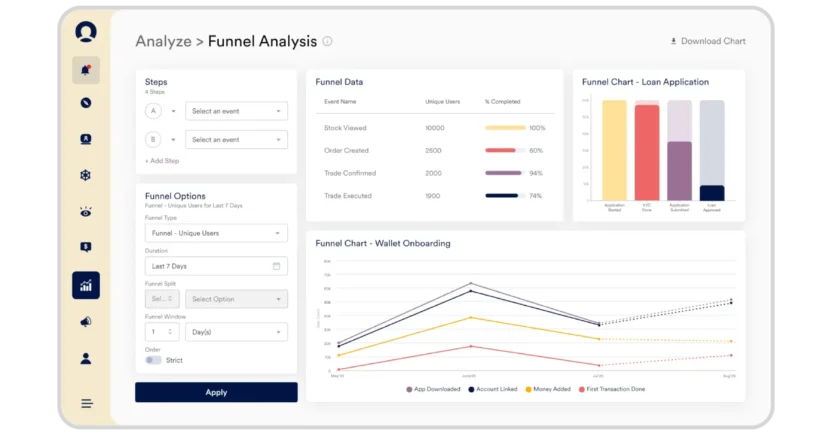
MoEngage is an agentic customer engagement platform built for consumer brands that need to do more than send basic emails. That’s why MoEngage stands out as one of the best Klaviyo alternatives for Shopify and Ecommerce brands in 2026.
Where Klaviyo grew up as an email-first tool for entrepreneurs and small businesses, and later added SMS, MoEngage was designed from the ground up to orchestrate personalized customer journeys across every touchpoint customers are on — email, SMS, mobile push, in-app, web push, on-site messaging, WhatsApp, and RCS — from a single connected workflow.
For Shopify stores running multi-channel retention programs, mobile apps, or global messaging audiences, that breadth of native channel coverage changes what’s operationally possible.
But does it hold up when your store setup isn’t standard? Just ask Stadium Goods. The New York-based sneaker and streetwear resale marketplace runs a custom-built inventory system that’s tightly coupled to Shopify, and getting that catalog to sync cleanly on its previous CRM platform was a constant struggle. After moving to MoEngage’s native Shopify integration, the catalog data started syncing automatically. The result? Stadium Goods saw 2X year-over-year growth in triggered revenue, and it now syncs MoEngage-built audience segments to Meta and Google to sharpen its paid media targeting.
The platform’s Merlin AI engine powers send-time optimization, channel routing, churn prediction, journey testing, and AI campaign decisioning.
Pricing model: Fair, usage-based pricing tied to Monthly Tracked Users (MTUs). You pay only for profiles that are actually active, that is, customers who engage with your emails, SMS, push notifications, or other campaigns. If a contact hasn’t engaged in six months or a year, they don’t add to your bill. This keeps costs predictable as you scale, no matter how large your contact database grows, and ensures your pricing reflects real engagement, not just your contact list size. That said, MoEngage offers two pricing plans — Growth and Enterprise.
G2 rating: 4.5/5
Channels: SMS, RCS, email, mobile and web push, WhatsApp, in-app and on-site messages, web personalization, Google Ads Audience, and Facebook Audience.
Standout Feature: AI Campaign Decisioning agent that clearly defines your campaign objectives and operational restrictions (like budgets) to deliver hyper-personalized experiences to every customer.
Best Fit: Mid-market and enterprise Shopify stores running omnichannel programs that need unified cross-channel analytics and predictable MTU-based pricing for truly active users.
Link to a Platform Tour:
Why MoEngage is a Klaviyo Alternative:
We sourced all of this information directly from Klaviyo’s website, with references, and it is accurate as of October 2026:
A) Native Omnichannel Support, including On-site Messaging and Web Personalization
Klaviyo offers basic on-site pop-ups with product recommendations that are similarly simple. Its main native channels are email and SMS, with push notifications, WhatsApp, and other channels requiring additional configuration or third‑party integration. That adds setup time and complexity.
MoEngage includes native on-site messaging and advanced web personalization, such as banners, nudges, and pop-ups triggered by Shopify store browsing behavior, cart activity, and purchase history. Its product recommendations draw on multiple data sources, including store events, app activity, and customer preferences, enabling real-time tailoring of messaging.
What’s more, MoEngage includes native support for email, SMS, WhatsApp, RCS, mobile push notifications, in‑app messaging, and web push, accessible from the same campaign builder. That means Shopify brands can launch and coordinate messages without extra connectors or manual setups.
Why it matters: For Shopify stores, richer on-site messaging and dynamic web personalization can capture intent while customers are actively browsing, improving conversions without relying solely on email or SMS follow-ups. Shopify marketing teams can also manage omnichannel programs from a single interface, reducing operational complexity and ensuring channel messages are aligned.
B) Unified Cross-Channel Analytics
Klaviyo’s reporting is strong for email and SMS revenue attribution, but the picture fragments when you move beyond those two channels. Push, in-app, and WhatsApp performance don’t appear in a unified view, and advanced analytics capabilities, including CLV dashboards, product analytics, and RFM (Recency, Frequency, and Monetary value) analysis, require paid add-ons that can significantly increase total cost as your team’s needs grow.
MoEngage includes a unified cross-channel dashboard covering Shopify store behavior, app activity, email, push, WhatsApp, and web in a single view. Core analytics include:
- Funnel analytics: Monitor how customers move from their first touchpoint (e.g., email link click) through Shopify store browsing, cart interactions, and final purchase.
- User path analysis: See omnichannel customer journeys such as: customer receives a push notification > visits the product page > adds to cart > completes purchase after a personalized WhatsApp reminder.
- Retention cohorts: Analyze repeat-purchase behavior, segmented by acquisition channel or campaign type.
- Predictive churn analytics: Identify at‑risk customers and trigger targeted win‑back flows automatically.
- Custom shareable dashboards: Export reports for your internal teams or schedule them as regular email digests.
All of these are included at no additional cost. Attribution is also configurable — your team can choose view-through, click-through, or in-session customer engagement metrics, depending on how you actually measure campaign impact.
Why it matters: Shopify marketing teams get a complete engagement picture from a single dashboard, enabling Shopify stores to optimize campaigns across channels, diagnose conversion drop-offs, and justify spend based on full customer journeys.
C) Dedicated Customer Success Team
Klaviyo’s support model is designed for smaller Ecommerce brands, with most accounts managed through shared support channels. Larger teams with complex multi‑channel programs often need more strategic guidance, but dedicated account management isn’t standard.
MoEngage offers enterprise‑grade customer success for Shopify brands, including proactive onboarding, regional support teams, dedicated Customer Success Managers (CSMs), Engagement Managers, Quarterly Business Reviews, and access to a Customer Advisory Board. This ensures teams get strategic help and execution guidance quickly, without waiting in long ticket queues.
Why it matters: Shopify stores scaling across multiple channels get a partner genuinely invested in their success. The results? Less time‑to‑value, less costly downtime, and faster execution of growth strategies.
These are just some of the differences between MoEngage vs. Klaviyo. Now, let’s move on to the other Klaviyo competitors for Shopify.
2. Best Klaviyo Alternative for Large Contact Lists: Brevo
Brevo is the best Klaviyo alternative for large contact lists because it doesn’t care how many contacts you store. You pay for the emails you send, so a 100,000-person list you mail twice a month doesn’t cost you more than a smaller one.
Where Brevo wins: Brevo puts email, SMS, WhatsApp, and transactional messages (order confirmations and shipping updates) in one account. It also includes a basic CRM and a website chat widget, which helps if you handle wholesale inquiries or customer conversations. Reviewers consistently praise its deliverability, and the AI writing tools speed up subject lines and copy for lean teams.
Where Brevo falls short: It’s a general marketing platform, not a Shopify specialist, so its prebuilt ecommerce flows are thinner than Klaviyo’s, and you’ll build more from scratch. Automation branching is more limited, with advanced branching reserved for higher plans, and segmentation is less granular. Send-based pricing can also backfire. Once you approach 10 emails per contact each month, the bill can climb past Klaviyo’s.
Why It’s a Klaviyo Alternative: Klaviyo wins on Ecommerce depth, predictive analytics, and flow complexity. Brevo wins on storage economics and channel breadth in a single account.
Pricing model: Based on emails sent, not contacts stored. Free plan available; paid plans start around $9/month.
G2 rating: 4.5/5
Channels: Email, SMS, WhatsApp, and transactional messaging
Best for: Brands with big lists that don’t email everyone every week
3. Best Klaviyo Alternative for Advanced Automation and CRM: ActiveCampaign
ActiveCampaign is the best Klaviyo alternative for advanced automation and CRM. Its visual builder handles branching logic that most Ecommerce tools can’t touch, and the CRM is built into the platform rather than bolted on.
Where ActiveCampaign wins: Its automation builder is arguably the deepest in this guide, with if/else paths, goals, split tests, and more than 900 prebuilt automation recipes. Lead scoring and deal stages can trigger campaigns directly. AI helps too: you can generate campaigns and automations from a prompt, and predictive sending picks delivery times. It also connects to 850+ apps, including Shopify.
Where ActiveCampaign falls short: Power comes with a learning curve. Building even moderately advanced flows means understanding how tags, scores, and pipelines connect, so onboarding is slower than with simpler tools. It isn’t a turnkey solution for Ecommerce either. There’s no native predicted lifetime value, and deeper Ecommerce features sit in higher tiers. SMS is an add-on, and costs rise as you add channels.
Why It’s a Klaviyo Alternative: Klaviyo is the more convenient choice for pure Shopify retail, with plug-and-play flows and strong revenue reporting. ActiveCampaign is the stronger foundation if you sell across models, such as DTC plus wholesale or services.
Pricing model: Contact-based, tiered by features. Entry plans start around $15 to $19/month for 1,000 contacts.
G2 rating: 4.4/5
Channels: Email, SMS (add-on), WhatsApp, site messaging, and chat
Best for: Teams whose automations are complex and tied to sales activity
4. Best Klaviyo Alternative for Behavioral Segmentation and Revenue Attribution: Drip
Drip was built for Ecommerce from day one, and it measures success in dollars rather than opens and clicks.
Where Drip wins: Customer timelines show every email, purchase, and site visit in one view, so you can see what actually led to a sale. Revenue dashboards track performance per campaign and per automation, and A/B tests compare variations by revenue per person. Built-in pop-ups, quizzes, and sticky bars feed straight into your automations, and every plan includes all features, so there’s no tier-hopping to unlock the good stuff.
Where Drip falls short: Drip is narrower than Klaviyo. It has no CRM or predictive analytics, and its branching is shallower. Klaviyo re-checks a contact’s eligibility at every step of a flow, while Drip relies on workflow goals to exit people. Reporting can feel fragmented, and costs rise quickly as your contact count grows.
Why It’s a Klaviyo Alternative: The two overlap heavily on segmentation and triggers. Klaviyo has the edge on analytics depth, predictive models, and integrations. Drip wins on workflow flexibility, revenue-based testing, and a cleaner interface for smaller teams.
Pricing model: Contact-based with unlimited email sends. Plans start at $39/month for up to 2,500 contacts, with all features included.
G2 rating: 4.4/5
Channels: Email, plus on-site forms, pop-ups, and quizzes
Best for: Email-led Shopify brands that want to segment on behavior and measure revenue
5. Best Klaviyo Alternative for Email Automation: Intuit Mailchimp
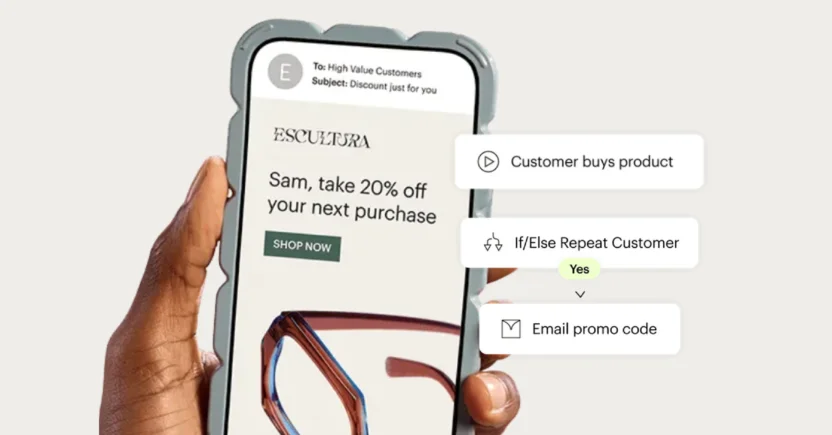
As one of the email marketing alternatives to Klaviyo, Mailchimp makes it straightforward to create, personalize, and automate email campaigns. Its drag-and-drop editor and segmentation tools help deliver targeted messages at the right time.
Where Mailchimp wins: Strong automation features with over 50 behavioral triggers. Easy email scheduling and reporting tools offer quick insights, and the template library is large, so you rarely start from scratch.
Where Mailchimp falls short: Some email templates are rigid without HTML knowledge. Some downtime has occurred during busy periods, and the interface could be updated for a better user experience.
Why It’s a Klaviyo Alternative: Klaviyo is the better pick for deep store data, real-time segmentation, and product-based automations. Mailchimp is easier to use and fits teams that want polished templates and basic customer journeys.
Pricing model: Four tiers. The free plan lets you send 500 emails/day or 1K/month to up to 500 contacts. But after 30 days, email support disappears, and you lose features like A/B testing. Paid plans start at $8.86/month for 500 contacts, scaling to $972.25/month for 200K contacts. SMS is available (US and UK only) as a paid add-on.
G2 Rating: 4.3/5
Channels: Email, SMS (US/UK paid plans), and MMS (US only, Standard/Premium)
Best Fit: Brands looking for strong email automation and basic personalization without complexity.
6. Best Klaviyo Alternative for Connecting Marketing and Sales Data: HubSpot Marketing Hub
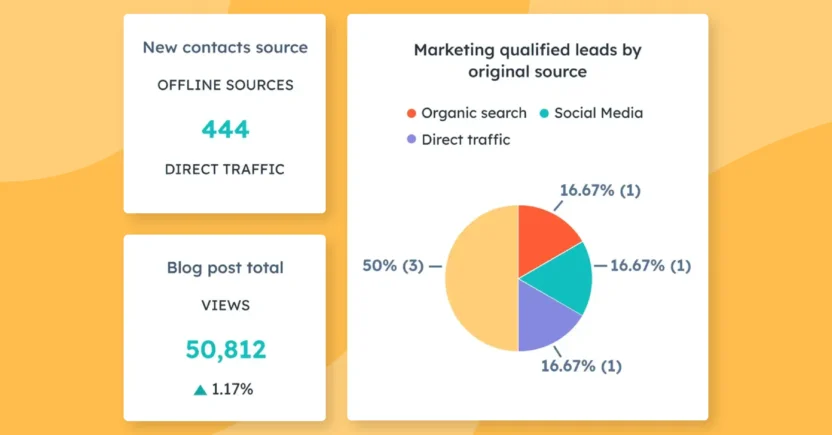
HubSpot Marketing Hub integrates directly with the HubSpot CRM, enabling marketing and sales teams to work from the same customer data. This supports personalized campaigns and performance tracking, making HubSpot one of the best Klaviyo alternatives.
Where HubSpot wins: Enables marketing-sales alignment, offers scalable personalization, and supports multiple channels, including WhatsApp (via integrations).
Where HubSpot falls short: The onboarding process can be complex and costly. Managing multiple datasets within one platform may also be challenging for smaller teams.
Why It’s a Klaviyo Alternative: Klaviyo was built for Ecommerce, so its Shopify integration, behavioral tracking, and prebuilt flows run deeper. HubSpot is stronger when inbound leads, content marketing, and sales pipelines drive revenue.
Pricing model: Starts at $890/month for 2K contacts, 3 users, and 5K campaigns, plus a $3,000 onboarding fee. Enterprise pricing starts at $3.6K/month for 10K contacts and 5 users, plus a $7,000 onboarding fee.
G2 Rating: 4.4/5
Channels: Email, SMS, social media, push notifications (via OneSignal integration), and WhatsApp
Best Fit: Teams requiring a marketing automation platform that’s fully integrated with CRM data.
6. Best Klaviyo Alternative for SMS-First Shopify Brands: Attentive
As one of the top alternatives to Klaviyo for Shopify brands, Attentive is an AI-powered marketing platform that helps brands deliver hyper‑personalized SMS and email campaigns at scale. Known for its mobile‑first approach and two‑way conversations, it enables brands to engage customers throughout their purchasing journey, from product launches to back‑in‑stock updates.
Where Attentive wins: Easy‑to‑use interface ideal for lean teams, quick campaign setup and management, and strong customer support with dedicated CSMs.
Where Attentive falls short: Attentive’s email functionality lacks depth in customization and reporting. Some Attentive users have also reported occasional inaccuracies in subscriber location detection.
Why It’s a Klaviyo Alternative: Klaviyo is the stronger all-around choice when email carries most of your revenue. Attentive is the stronger choice when SMS does.
Pricing model: Attentive’s pricing depends on your contact list size, how many messages you send, how many channels you send messages on, and whether you need any premium AI products, like AI Grow and AI Pro. You need to pay for what you actually use. Bundling multiple channels together can make you eligible for discounts, too.
G2 Rating: 4.5/5
Channels: Email, SMS/MMS, RCS Business Messaging, and push notifications
Best Fit: Shopify stores seeking an easy‑to‑use SMS marketing platform with responsive customer support and basic email capabilities, ideal for small teams prioritizing mobile‑first customer engagement.
8. Closest Klaviyo-Style Alternative for Small Stores: Omnisend
Omnisend is built for Ecommerce marketing, with email, web push, and SMS in the same workflow, and it covers the standard flows most stores run: welcome series, abandoned cart, post-purchase, and win-back.
So why call it the closest match to Klaviyo? Because the day-to-day experience feels familiar. Pre-built flows, segmentation based on shopping behavior, and revenue tracking tied to campaigns and automations all work the way Klaviyo users expect. Most of the learning curve is gone.
Where Omnisend wins: Product pickers drop catalog items straight into emails, discount code generation is built in, and gamified forms like a spin-to-win wheel help grow your list. Its AI product recommender lets you control which items appear and exclude others, and AI can suggest audience segments. Reviewers note responsive live chat, and Omnisend says 24/7 chat is included on all plans. Multi-store management and deliverability reporting for email and SMS round it out.
Where Omnisend falls short: It has no Klaviyo-style CRM contact profiles or predicted next order date, and it can’t segment by predicted lifetime value, even though it shows that metric at the contact level. The integration library is smaller than Klaviyo’s, and the landing page builder is fairly basic.
Why It’s a Klaviyo Alternative: Klaviyo has the edge on predictive analytics and segmentation depth. Omnisend wins on ease of use and on keeping email, SMS, and web push in a single workflow.
Pricing model: Contact-based and tiered by plan. A free plan is available (250 contacts, 500 emails/month), and paid plans start at $16/month for 500 contacts and 6,000 emails. The Pro plan adds SMS and unlimited email sends.
G2 rating: 4.6/5
Channels: Email, web push, and SMS (Pro plan)
Best for: Shopify and WooCommerce stores that want Klaviyo-like Ecommerce automation across email, SMS, and web push.
Other Potential Alternatives to Klaviyo
1. Iterable
Iterable is well‑known for covering the full spectrum of cross‑channel campaigns, from creation to optimization, across email, SMS, push, and more. Its segmentation flexibility is a major plus, and it integrates with over 100 apps, making it adaptable to a variety of Martech stacks.
For Shopify brands, that level of segmentation means you can target very specific customer behaviors and transaction patterns.
Where it falls short: Reporting depth is limited without connecting to a third‑party BI or your data warehouse. If you want a complete, in‑platform view of the customer journey from first touch to purchase and repeat orders, you may need extra tools. Some teams have also noticed slower performance when building complex multi‑step automations, which can drag down campaign turnaround time.
If you’re looking for Iterable alternatives, you’ll probably be aiming for a CEP that combines strong segmentation with faster orchestration and more unified analytics out of the box.
2. Salesforce Marketing Cloud
Salesforce Marketing Cloud is a familiar choice for large enterprises that need data‑driven customer engagement and advanced CRM integration.
Where it falls short: As a legacy platform, onboarding it with modern Ecommerce stacks like Shopify often takes significant technical effort. The platform’s rigidity, high maintenance costs, and complex navigation can slow teams down — not ideal when you’re running weekly product drops or flash sales.
For many marketing teams, the need for faster setup, less admin overhead, and smoother integration with newer systems makes them choose from among alternatives to Salesforce Marketing Cloud.
3. Oracle Responsys
Oracle Responsys offers multilingual campaign capabilities, so you can manage variations for different languages within the same campaign. It’s helpful for brands selling in multiple countries or regions.
Where it falls short for modern Ecommerce: Omnichannel coverage is incomplete. It focuses on email, push, and SMS, but doesn’t natively support increasingly important channels like WhatsApp or RCS — both of which are seeing rising adoption in customer engagement for retail. Workflow speed can also take a hit if you have to set up many campaigns in quick succession, especially during peak sales seasons.
Brands that switch from Responsys often look for alternatives to Oracle Responsys that match its localization strengths, but add more native channels and smoother campaign execution.
Best Klaviyo Alternatives by Business Size
The best Klaviyo alternative depends on your brand’s size, contact volume, marketing team, and channel strategy. A startup that needs newsletters, segmentation, and basic Shopify automations doesn’t need the same platform as a 100,000-contact Ecommerce brand running email, SMS, WhatsApp, mobile push, and advanced customer retention programs.
The table below provides a quick recommendation by business size.
| Business size | Recommended Klaviyo alternatives | Why consider them? |
| Startups and small Shopify stores | Brevo, Omnisend, or Attentive | Lower costs, simple email and SMS, fast setup |
| Mid-size Ecommerce and growing DTC brands | MoEngage or Drip | Omnichannel retention (MoEngage); behavioral automation with unlimited sends (Drip) |
| Enterprise Ecommerce brands | MoEngage or HubSpot | Scale, unified analytics, dedicated support (MoEngage); CRM-led marketing (HubSpot) |
What are the Best Klaviyo Alternatives for Startups and Small Shopify Stores?
For startups and small Shopify stores, Brevo and Omnisend are the best Klaviyo alternatives. Brevo bills by emails sent instead of contacts stored, starting at $9/month. Omnisend gives you Klaviyo-style Shopify flows across email, SMS, and web push from $16/month.
Why do small stores leave Klaviyo? Almost always for one of two reasons: the bill or the complexity.
On price, Klaviyo runs roughly $20/month at 500 profiles and about $150/month at 10,000. Brevo’s paid plans cover 10,000 contacts with 20,000 monthly emails for around $32/month. That’s a big gap when you’re watching margins.
On complexity, you don’t need a platform with a steep learning curve to send a welcome series, an abandoned cart email, and a monthly newsletter. Brevo and Omnisend are much faster to learn.
Here’s how to choose between them:
- Choose Brevo if you have a large list, but email it occasionally. You pay for what you send, so a big, quiet list doesn’t punish you. It’s also the most affordable pick if all you need is newsletters, basic segmentation, and simple marketing automations. The trade-off is that its prebuilt Ecommerce flows are thinner, so expect to build more yourself.
- Choose Omnisend if you want the closest like-for-like Shopify experience at a lower price. Its pre-built abandoned cart, welcome, and Shopify post-purchase email flows work out of the box. Its predictive analytics are less developed than Klaviyo’s, though.
Both have free plans, so you can test with real sends before you cancel anything. If you need deeper, CRM-style automation more than Ecommerce templates, ActiveCampaign is worth a look, but its learning curve is steeper.
But at the growing stage, the question changes. It’s no longer “Can we send the right emails?” It’s “Can we send the right message, on the right channel, at the right moment?” That’s usually when teams start asking for more strategic capability, not just a different tool.
Klaviyo Alternatives for Mid-Size Ecommerce and Growing DTC Brands
For mid-size Ecommerce and growing DTC brands, MoEngage and Drip are the strongest Klaviyo alternatives. Drip suits email-led teams that want deep behavioral automation and revenue-focused testing. MoEngage suits brands whose growth now depends on coordinating more channels, with unified analytics and AI.
Drip fits email-led programs that need sharper segmentation. It tracks events like product views, cart activity, and purchases, so you can build segments around what customers actually do. Unlike Klaviyo, which caps each flow at one trigger, Drip lets you enroll people from several entry points in a single workflow, which keeps your automation library cleaner as it grows. A/B tests compare variations by revenue per person instead of opens and clicks.
MoEngage fits brands that are building coordinated, multi-channel lifecycle programs. A journey can follow up on the channel each shopper responds to, then stop once they buy. On-site banners, nudges, and pop-ups capture intent while people are still browsing, and a unified dashboard covers funnels, user paths, retention cohorts, and predictive churn. MoEngage’s Merlin AI handles send-time optimization per user per channel, churn prediction, and Merlin AI Segment Assist, while RFM and affinity segments update in real time, so a lean team can personalize at scale.
For a growing DTC brand looking to save on costs, the decision depends on the type of scale involved:
- Choose MoEngage if you need multiple channels, unified analytics, mobile engagement, or a broader customer retention strategy.
- Choose Drip if email remains the primary channel and you want ecommerce-focused automation with less platform breadth.
What are the Alternatives to Klaviyo for Enterprise Brands?
For enterprise brands, the best Klaviyo alternatives are MoEngage and HubSpot. MoEngage wins on omnichannel orchestration, AI decisioning, and dedicated support. HubSpot wins when marketing needs to share one customer record with sales and service.
Klaviyo is excellent at Ecommerce email and SMS, but enterprise teams tend to hit the same walls: channels beyond email and SMS aren’t native, advanced analytics like CLV dashboards and RFM analysis come as paid add-ons, and support runs mostly through shared channels.
Three things make MoEngage the stronger fit at this scale.
- Orchestration: One workflow coordinates more than 16 channels with fatigue management built in, which matters when several teams are messaging the same customer.
- AI decisioning: Its AI campaign decisioning agent takes your objective and constraints, such as budgets, and personalizes each customer’s experience, so you aren’t hand-building every branch.
- Support: Dedicated Customer Success Managers, Engagement Managers, and quarterly business reviews give large teams strategic guidance instead of a ticket queue.
HubSpot’s case rests on one capability: a single CRM record across marketing, sales, and service. For enterprises where campaigns are tied to pipeline, that unified data and journey-wide reporting is hard to match. The catch is Ecommerce depth. Its Shopify tooling is lighter than platforms built for Ecommerce, so it works best for brands with a strong B2B or CRM-led motion alongside DTC.
The bottom line: If you need every channel, intelligent decisioning, and strategic support, start your enterprise customer engagement platform shortlist with MoEngage. If your priority is tying marketing directly to sales, add HubSpot.
Best Klaviyo Alternatives by Capability
Klaviyo is a powerful Ecommerce marketing platform, but it isn’t the best fit for every marketing team or every use case. Some brands need deeper personalization. Others want predictive AI, more flexible testing, a built-in CRM, or faster customer support.
The best Klaviyo alternative depends on the capability you need most. Here’s how the leading alternatives to Klaviyo compare by capability.
| Capability | Top Klaviyo alternatives | Why they win |
| Personalized marketing | MoEngage, Drip | Real-time behavioral segments and on-site personalization (MoEngage); product recommendations and customer timelines (Drip) |
| AI predictive modeling | MoEngage, ActiveCampaign | Churn prediction and AI campaign decisioning (MoEngage); predictive sending and AI-built automations (ActiveCampaign) |
| A/B testing | Drip, ActiveCampaign | Revenue-per-person testing (Drip); split tests inside the flow (ActiveCampaign) |
| Analytics | MoEngage, Drip | One cross-channel dashboard (MoEngage); revenue and customer timeline views (Drip) |
| CRM and sales automation | HubSpot, ActiveCampaign | Full CRM across marketing, sales, and service (HubSpot); built-in CRM with lead scoring (ActiveCampaign) |
| Customer support | MoEngage, Attentive | Dedicated customer success teams instead of ticket queues |
Best Klaviyo Alternatives for Personalized Marketing
For Shopify personalized emails and other personalized marketing campaigns, MoEngage and Drip are the best Klaviyo alternatives. MoEngage personalizes messages across channels and on your store in real time. Drip personalizes email around what each customer has viewed, bought, and clicked.
MoEngage builds recommendations from multiple data sources (store events, app activity, and user preferences), then applies them everywhere a customer shows up. That includes on-site banners, nudges, and pop-ups triggered by browsing and cart behavior. Segments like RFM and affinity update in real time, so the message matches what the shopper just did, not what they did last week.
Drip is the better pick if email is your main channel. It inserts product recommendations based on browsing and purchase history, and its customer timeline shows every email, purchase, and site visit in one place. That context makes it easier to personalize on purpose, not by guesswork.
Best Alternatives to Klaviyo for Advanced AI Predictive Modeling
For AI and predictive modeling, MoEngage and ActiveCampaign are the strongest Klaviyo alternatives. MoEngage predicts churn and acts on it automatically. ActiveCampaign uses AI to time sends and build automations. Neither fully replicates Klaviyo’s predicted CLV, so be clear about what you actually use.
Let’s be straight here. Klaviyo’s predictive analytics (predicted lifetime value, churn risk, expected next order date) are among the best in the category. If your segments rely on those every week, expect to lose something by switching.
What you can gain is AI that does more than score customers. For instance, MoEngage’s Merlin AI predicts churn and triggers win-back flows automatically. Like we’ve said before, its campaign decisioning agent goes a step further: you set the objective and constraints, like budgets, and it decides what each customer should receive. Send-time optimization also works per user and per channel.
ActiveCampaign takes a different route. Its predictive sending picks the best delivery time, AI segmentation suggests audiences, and you can generate whole campaigns and automations from a single prompt. That’s a good fit for lean teams that want AI to speed up the build.
Are There Better Alternatives for A/B Testing Than Klaviyo?
Drip and ActiveCampaign are the best Klaviyo alternatives for A/B testing. Drip tests by revenue per person, not opens and clicks. ActiveCampaign lets you split and test inside the same flow, including timing, messaging, and conditions.
ActiveCampaign wins on testing the journey itself. You can split a path within a flow and test delay times, message variants, and branching logic, then pair the results with predictive sending. That’s useful when the question isn’t “Which email won?” but “Which sequence works?”
Whichever platform you choose, ask whether it supports holdout testing, not just variant testing.
Alternatives to Klaviyo Analytics
For analytics, MoEngage is the best Klaviyo alternative, with Drip a solid pick for email-led revenue reporting.
Klaviyo’s reporting is strongest for email and SMS revenue. But you have to export raw data and build out pivot tables to find what you need. The issue is fragmentation. Once you add push, in-app, or WhatsApp, performance stops showing up in one view.
MoEngage solves that by covering Shopify store behavior, app activity, email, push, WhatsApp, and web together. It puts funnels, user paths, retention cohorts, and predictive churn in one cross-channel dashboard. You can follow a customer from a push notification to a product page to a purchase after a WhatsApp reminder, and choose view-through, click-through, or in-session attribution to match how you measure results.
If you’re email-led, Drip’s revenue dashboards and per-campaign revenue stats cover most of what you need without the overhead.
Best Klaviyo Alternatives With CRM and Sales Automation
For CRM and sales automation, HubSpot and ActiveCampaign are the best Klaviyo alternatives. HubSpot gives marketing, sales, and service one shared customer record. ActiveCampaign builds a CRM into its automation, so deal stages and lead scores can trigger campaigns.
Klaviyo doesn’t have a sales CRM. That’s fine for pure DTC, but it’s a problem if your brand also runs wholesale, B2B accounts, or high-consideration sales.
HubSpot is the stronger pick for larger teams. Every touchpoint ties back to one timeline, so marketing can see what sales and support have already said. ActiveCampaign is the leaner option. Its lead scoring moves contacts into pipelines based on behavior, and you can trigger email or SMS from deal stage changes without syncing a separate CRM.
The trade-off for both is Ecommerce depth. Neither matches platforms built for Shopify, so they fit best when CRM-led selling matters as much as DTC.
How Does Customer Support Compare Between Klaviyo and Its Competitors?
MoEngage and Attentive stand out on customer support. Both assign dedicated customer success contacts instead of routing you through a shared ticket queue. Klaviyo’s support is mostly ticket-based, with chat on paid plans available 24/5 and no live chat on the free plan.
Support is one of the most repeated complaints we’ve heard about Klaviyo. A director of marketing at an audio products brand said that service has taken a nosedive since removing individual account managers. A VP of digital strategy at a consumer brand told us that she used to know her Klaviyo rep by name. Now it’s tickets.
MoEngage’s customer support model is built for teams that want strategy, not just fixes: dedicated Customer Success Managers, Engagement Managers, quarterly business reviews, and regional support teams. Attentive is the better fit for lean, SMS-first teams, with dedicated CSMs and an easy-to-use platform that doesn’t need much hand-holding.
Before you sign with any vendor, ask who your named contact is, what response times are in writing, and whether onboarding is included.
Best Klaviyo Alternatives by Channel
Klaviyo is a strong choice for Shopify email and SMS marketing, but your channel mix may have outgrown what it does best. Maybe you need mobile push, in-app messaging, WhatsApp, or on-site personalization. Maybe your team wants one platform to coordinate every customer touchpoint instead of stitching together several tools.
The best Klaviyo alternative depends on the channel that drives the most value for your brand.
| Channel | Top alternatives to Klaviyo | Why they win |
| MoEngage, Brevo, Drip | Journey-level orchestration and send-time optimization (MoEngage); deliverability and transactional email in one account (Brevo); behavioral triggers and revenue-based testing (Drip) | |
| SMS | Attentive, MoEngage | Two-way, SMS-first conversations (Attentive); SMS coordinated with every other channel (MoEngage) |
| Mobile app retention | MoEngage | Native mobile push and in-app messaging tied to Shopify and app data |
| Web push, in-app, and on-site | MoEngage, Drip | On-site messaging and web personalization (MoEngage); on-site forms, quizzes, and pop-ups that feed automations (Drip) |
| Email + SMS + WhatsApp | Brevo, MoEngage | WhatsApp, SMS, and email in one platform without per-contact pricing (Brevo, MoEngage) |
Top Email Marketing Alternatives to Klaviyo
For email, the top Klaviyo alternatives are MoEngage, Brevo, and Drip. MoEngage wins on coordinating email with every other channel. Brevo wins on deliverability and transactional email. Drip wins on behavioral triggers and revenue-based testing.
Email isn’t the problem with Klaviyo. Plenty of brands love its email builder. The issue is what happens when email has to work alongside everything else.
That’s where Shopify email marketing apps like MoEngage come in. In MoEngage, email sits inside the same journey as SMS, push, WhatsApp, and on-site messages, so you’re not building a separate email program and hoping it lines up with the rest. It also picks the best send time per user, per channel, which means your email lands when each person is most likely to open it. Think about what that does for a lean team. You set the journey once and let the platform handle timing.
Brevo is the pick when reliability matters most. Its marketing and transactional email run in the same account, so promotions, order confirmations, and shipping updates share one sending setup. Reviewers consistently praise its deliverability, even though the templates feel a little dated.
Drip is for teams that want to get granular. It triggers email off browsing, product views, cart activity, and purchases, and it lets people enter one workflow from several points. Klaviyo caps each flow at a single trigger. Drip also judges A/B tests by revenue per person, so the winning subject line is the one that actually earns more.
Best Klaviyo SMS Alternatives
Attentive is the best Klaviyo SMS alternative for brands where text is a core revenue channel. It’s built SMS-first, with two-way conversations, strong list-growth tools, and dedicated customer success managers. MoEngage is the better fit if you want SMS coordinated with other channels.
Why does Attentive win? Because SMS is the whole product, not an add-on. It supports two-way conversations, so shoppers can reply and get an answer. It offers a wide range of pop-ups and sign-up forms for growing your subscriber list, and its personalization draws on browsing activity, purchase history, and product interests. Launches, flash sales, and back-in-stock alerts are exactly what it was designed for.
The trade-off? Its email features are lighter, so email-first brands may feel the gap.
Can you keep Klaviyo for email and move only SMS to one of the best Shopify SMS apps? Absolutely, and plenty of brands do. Just go in with your eyes open.
But two platforms mean two sets of subscriber data to reconcile.
That’s the case for MoEngage. SMS and RCS run in the same builder as email, push, and WhatsApp, so a journey can choose the best channel for each customer instead of sending the same message everywhere. If SMS is your whole game, go with Attentive. If it’s one channel in a bigger program, MoEngage keeps everything in one place.
What Platform is Better Than Klaviyo for Mobile App Retention?
MoEngage is the better platform for mobile app retention than Klaviyo. It supports mobile push and in-app messaging natively, and it ties app behavior to Shopify store activity, so you can retain customers across your app and your storefront from one journey.
Here’s the gap. Klaviyo’s core is email and SMS, so push and other app channels need extra configuration or third-party tools. If you’ve built a mobile app, that’s a real problem. Your most engaged customers are the ones you can reach least easily.
MoEngage was built for this. A customer opens your app, browses a product, and leaves. The journey can follow up with a push notification, then an in-app message the next time they open the app, then a WhatsApp reminder if they still haven’t bought. Everything reports in one dashboard, including retention cohorts and predictive churn, so you can see which customers are drifting away and trigger win-back flows before they’re gone.
Attentive also supports push, but it’s built around mobile-first SMS rather than app retention.
Don’t have an app yet? Then you probably don’t need this today. But if one’s on your roadmap, choose a platform that’s ready for it.
Best Klaviyo Alternatives for Web Push, In-App, and On-Site Engagement
MoEngage is the best Klaviyo alternative for web push, in-app, and on-site engagement because it offers all three natively, with web personalization built in. Drip is a good pick if you mainly want on-site forms, quizzes, and pop-ups feeding your email automations.
Klaviyo’s on-site tools are basic. Its pop-ups work fine for collecting emails, but they don’t do much beyond that. Web push notifications and in-app messaging usually mean bolting on another tool.
MoEngage treats the website as another channel in the journey. Banners, nudges, and pop-ups can trigger off browsing behavior, cart activity, and purchase history, and recommendations draw on store events, app activity, and user preferences. So a shopper who viewed a jacket twice sees a different homepage than one who just bought it. Web push and in-app messages come from the same campaign builder, which means there’s no new connector to maintain.
Drip takes a simpler route, and sometimes simple is exactly right. Its pop-ups, quizzes, sticky bars, and gamified opt-ins feed directly into automations. If web push is your only extra channel, Omnisend also includes it in every paid plan.
Best Klaviyo Alternative for Multichannel Ecommerce Marketing (Email, SMS, and WhatsApp) Without High Contact Fees
Brevo and MoEngage are the best Klaviyo alternatives for email, SMS, and WhatsApp without high contact fees. Brevo charges by emails sent, so a big list doesn’t raise your bill. MoEngage bills on Monthly Tracked Users, meaning customers who actually engage.
Both of these platforms flip Klaviyo’s profile-based pricing model, and both handle WhatsApp natively. Brevo is the more budget-friendly route. Email, SMS, and WhatsApp live in one account, and you can store unlimited contacts without paying extra. The catch is that its Shopify flows and automation branching are lighter than Klaviyo’s, so you’ll build more yourself.
MoEngage is the route for brands that want more than 3 channels. Email, SMS, WhatsApp, push, in-app, and on-site messages run from one journey builder, and dormant contacts don’t inflate your bill because pricing follows engagement.
Which one should you pick? Choose Brevo if you need 3 channels at the lowest cost. Choose MoEngage if you’re planning to grow beyond them.

Klaviyo Pricing vs. Alternatives
Klaviyo pricing can work well for a growing Shopify store, especially when your list is clean, and you actively use its segmentation, predictive analytics, and Ecommerce reporting. But the cost can become harder to justify as your audience grows.
That’s because Klaviyo’s pricing is influenced by the number of profiles you can market to, while other platforms use different models.
| Platform | How you’re billed |
| Brevo | Emails sent, not contacts stored |
| Drip | Contacts, with unlimited email sends |
| Omnisend | Contacts, tiered by plan |
| ActiveCampaign | Contacts, gated by plan tier |
| HubSpot | Marketing contacts, by tier |
| Attentive | Custom: contacts, messages, and channels |
| MoEngage | Monthly Tracked Users (MTUs) |
There’s no universally cheapest Klaviyo alternative. The right choice depends on your contact count, monthly email volume, SMS usage, WhatsApp requirements, and the depth of automation you need.
How to Compare Pricing Between Klaviyo and Competitors
Don’t compare platforms based on their starting prices alone. That number usually reflects a small contact tier, limited sending volume, or a plan that excludes the capabilities your team actually needs.
Instead, compare the total cost of running your marketing program.
Start with your marketable contact count, not just your total database size. Then estimate how many emails, automated text messages, WhatsApp messages, and push notifications you’ll send each month. Finally, add the cost of analytics, onboarding, implementation, additional users, and integrations.
| Cost factor | Why it matters |
| Marketable contacts | Klaviyo and several competitors increase pricing as your active audience grows |
| Email volume | Brevo and some other platforms price primarily by sends |
| SMS usage | SMS is often billed separately from email |
| WhatsApp messaging | Templates, conversations, and regional fees may be charged separately |
| Push and in-app engagement | Some platforms include these channels; others price them separately |
| Automation features | Advanced branching, testing, and predictive tools may be plan-dependent |
| Analytics and attribution | Revenue reporting and cross-channel analytics may require higher tiers |
| Number of stores or accounts | Multi-brand Shopify operations may incur additional costs |
| Support and onboarding | Enterprise onboarding, migration, and dedicated success teams can affect total cost |
| Implementation | Custom integrations, data migration, and technical setup can exceed software costs |
Here’s the question to ask: Are you paying for the contacts you store, the messages you send, or the customers you actively engage?
That answer can change which Klaviyo alternative is most cost-effective.
Klaviyo Alternatives Pricing at 10,000 Contacts
At 10,000 contacts, the best-fit pricing models are Brevo’s send-based billing and Drip’s contact-based billing with unlimited sends. Which one wins depends on how often you email. ActiveCampaign also works if automation depth matters more than cost predictability.
| Platform | Pricing model | Why it fits 10,000 contacts |
| Brevo | Pay per email sent; unlimited stored contacts | Your list size doesn’t drive the bill, so a 10K list you email occasionally stays cheap |
| Drip | Pay per contact; unlimited email sends | Send volume doesn’t matter, so high-frequency lifecycle programs stay predictable |
| ActiveCampaign | Pay per contact, tiered by features | You pay for automation and CRM depth, with all email features on every plan |
At this size, most contact-based platforms are priced close to Klaviyo. So switching to another contact-based tool won’t save much on its own. The real difference comes from changing the billing model.
Brevo’s model suits a 10,000-contact list you don’t email constantly. You pay for what you send, not for contacts sitting in your database, as you do with Klaviyo. The catch is that costs climb as send frequency does, so model your actual calendar first. Brevo also keeps email, SMS, and WhatsApp in one account, which helps keep multichannel costs together.
With Drip, you pay based on contacts, but sends are unlimited. If you run daily flows, frequent campaigns, and layered lifecycle sequences, you never ration messages against a monthly cap. Klaviyo limits sends per profile, so this matters for high-volume programs.
ActiveCampaign sits in the middle. Contact-based pricing is predictable, and every plan includes the core email features. You upgrade for channels, users, and CRM, not to unlock basics. It’s a fit if your 10,000 contacts need complex branching and lead scoring.
Klaviyo Alternatives Pricing at 100,000+ Contacts
At 100,000+ contacts, the best-fit pricing model is engagement-based billing, and that’s where MoEngage stands out. It bills on Monthly Tracked Users, so dormant contacts don’t inflate your bill. Attentive and HubSpot also work at this scale, with custom or tiered pricing.
| Platform | Pricing model | Why it fits 100,000+ contacts |
| MoEngage | MTU-based (Growth and Enterprise plans) | Bills on customers who actually engage, so large dormant lists don’t drive cost |
| Attentive | Custom, based on contacts, message volume, and channels | Usage-based, with discounts for bundling channels |
| HubSpot | Marketing contacts, by tier | You pay only for contacts you actively market to, but tiers jump sharply |
The billing model matters far more than any entry price. Think about it: on a profile-based pricing model like Klaviyo’s, you pay for every emailable contact, even though a big share of a list this size is probably inactive.
MoEngage’s MTU model fixes that. You pay for customers who engage with your emails, SMS, push, or other campaigns. If someone hasn’t engaged in 6-9 months or a year, they don’t add to your bill. So your cost tracks real activity, not list growth.
Attentive’s usage-based model fits when SMS drives most of your revenue. You pay for what you actually use, and bundling channels can unlock discounts.
HubSpot works if CRM is central to how you sell. Its marketing-contacts model charges only for contacts you market to, but moving between tiers can mean big jumps, and onboarding fees add to the total.
Before you sign with anyone at this scale, ask 5 questions.
- What’s the price at my current volume?
- What’s the price at double that?
- Which channels cost extra?
- What do onboarding and migration cost?
- And what happens to my bill if my list shrinks?
Can’t get a clear answer to all five? Keep looking.
Migration From Klaviyo
Moving off Klaviyo sounds scarier than it is. Your contacts export cleanly. The real work is rebuilding what sits on top of them: flows, segments, templates, and tracking. Plan for that, and the move goes smoothly. Skip it, and you’ll feel it in your Q4 revenue.
Which Klaviyo Alternative Has the Smoothest Migration?
The Klaviyo alternative with the smoothest migration is the one whose team does the heavy lifting with you. Look for vendors that rebuild flows, run in parallel with Klaviyo, and stay involved after launch. Self-serve import tools move contacts, but they don’t move automations.
Here’s what that means in practice. Flows don’t transfer between platforms, and predictive scores won’t carry over either. SMS lists may also need fresh consent before you can text anyone. So the smoothest migration isn’t about the ‘import’ button. It’s about who helps you rebuild, test, and go live without dropping a single abandoned cart email along the way.
Ask every vendor these 4 questions before you sign:
- Will your team rebuild my flows, or hand me a guide?
- Can we run in parallel while Klaviyo stays live?
- How long do comparable migrations take?
- And what support do I get in the first 60 days?
Vague answers are a warning sign.
MoEngage is a good example of the managed approach. Its team supports migration with parallel setup while your existing platform keeps running, and the Drop app launched in as little as 7 to 10 days. Timelines vary with the number of channels, segments, and integrations, so treat that as a benchmark, not a promise.
One last tip: don’t switch right before your busiest season. Give yourself a few weeks of buffer, and you’ll be glad you did!
5 Migration Strategies When Switching To a Klaviyo Alternative
Switching from Klaviyo or another customer engagement platform to a Klaviyo competitor may feel straightforward, especially if you’ve only been running email and SMS campaigns. But in reality, migrations often fail when teams skip critical planning steps.
You might discover too late that the new platform can’t replicate existing automations. Or lose historical email/SMS campaign data. Or rush timelines without proper testing. The list can be endless!
The key is to approach migration as a structured project, with clear milestones, defined responsibilities, and vendor involvement where needed.
Here are proven customer engagement platform migration strategies to ensure your move to a Klaviyo alternative is smooth and successful.
1. Build a Detailed Migration Plan
List exactly what you’re migrating, and in what order. This should cover:
- Subscriber data (properties, attributes, tags)
- Behavioral events and triggers used in campaigns
- Segmentation logic and filtering rules
- Currently active email/SMS campaigns and automation series
- Integration points with Shopify, payment systems, and analytics tools
- Templates, naming conventions, and branding elements
Document your current setup in Klaviyo or other existing CEP and map it to your desired state in the new platform.
For example, if you’re switching to MoEngage for its AI-powered journey optimization, decide whether those capabilities will be active from day one or phased in later. If you’re moving to HubSpot Marketing Hub for CRM alignment, plan how to migrate and merge existing customer profiles to avoid duplicates.
Next, break the migration into logical phases, such as:
- Phase 1: Data export from Klaviyo and cleanup
- Phase 2: Import into the new CEP
- Phase 3: Workflow recreation
- Phase 4: Integration testing
- Phase 5: Parallel running before full switch
Each phase should have success criteria before proceeding. Include buffer time for troubleshooting, as delays are common during data imports and integration checks.
2. Assemble a Cross-Functional Migration Team
Migrating from Klaviyo or any other CEP impacts data integrity, compliance, and operations.
Your migration team should include:
- Marketing to ensure campaigns and customer journeys function correctly
- Technical/Engineering to handle API integrations, Shopify sync, SDK usage (if applicable)
- Product/Operations to prioritize new features and manage workflow changes
- Data/Analytics to verify tracking accuracy and reporting continuity
- Compliance/Security to ensure customer data handling aligns with regulations
Appoint a single migration lead — someone with enough authority to enforce timelines and approvals — who will also be the primary contact for the vendor’s onboarding/support team.
If you choose platforms like MoEngage that offer managed migration services, leverage their expertise. For example, MoEngage has migrated hundreds of campaigns in a matter of weeks, with improvements in customer engagement metrics driven by both technical readiness and coordinated change management.
3. Audit and Improve Documentation
Before choosing a Klaviyo alternative, assess the quality of its technical and onboarding documentation:
- Are APIs and integration guides accurate and up-to-date?
- Are there clear instructions for Shopify integration?
- Are there examples for building templates, triggers, and workflows?
For less technical teams, platforms with strong no-code configuration and visual guides (like HubSpot) reduce reliance on engineering resources during setup.
Internally, create your own migration reference that covers:
- Campaign logic and workflow diagrams
- Data architecture
- Naming conventions and segmentation patterns
This will become invaluable for future platform changes or onboarding new staff.
4. Test Workflows Under Real Conditions
Stopping your existing CEP, such as Klaviyo, before validating your new platform can cause significant downtime, especially for transactional and high-value campaigns like abandoned cart flows.
That’s why it’s better to start testing as early as possible:
- Use a staging or sandbox environment if available
- Validate that all integrations work as intended
- Check message rendering across channels (email, SMS, and push, if applicable)
- Confirm automation triggers fire correctly
Platforms like MoEngage, for instance, provide real-time campaign previews and parallel-run migration support, making it easier to see exactly how messages will appear before going live.
Keep Klaviyo running until you’re confident every workflow in the new platform works under production-like conditions. This ensures you have a fallback if issues arise before or during go-live.
5. Secure Comprehensive Onboarding and Post-Migration Support
The first 30-60 days after switching are critical for adoption and optimization. Customer engagement software varies widely in its onboarding approach.
HubSpot, for example, charges for structured onboarding, but offers in-depth, guided sessions. MoEngage includes professional services and ongoing optimization reviews.
Some of the onboarding and support terms you should negotiate before signing include:
- Response time SLAs during migration and post-launch
- Scheduled check-ins for performance reviews
- Role-specific training for marketing, data, and ops teams
At the end of the day, ongoing vendor support can drive tangible benefits. For example, MoEngage’s strategic onboarding helped an agency client save $18,000 annually, while improving campaign results through weekly sessions and optimization planning.
What Unique Strengths Does Klaviyo Have, and When Should You Stay?
Let’s be fair. Klaviyo became the default for Shopify stores for a reason, and switching to a Klaviyo alternative isn’t always the right move. If the strengths below describe how your team actually works, staying put may beat the cost and risk of a migration.
Start with the data. Klaviyo’s Shopify sync is among the most mature on the market, and its predictive metrics, like expected next order date and predicted lifetime value, are built on ecommerce-specific models. If your segments lean on those every week, you’ll feel the loss. Predicted scores don’t carry over to a new platform.
Then there’s the team factor. Klaviyo offers a large template library, deep flow-building options, and a big community of agencies and freelancers who know it well. A team that builds complex flows confidently in Klaviyo can lose real productivity in the first few months on a new tool. That’s a cost worth counting!
So When Should You Stay in Klaviyo?
Consider staying in Klaviyo if:
- Email and SMS drive nearly all your revenue
- You actively use its predictive segments
- Your bill still feels fair for the results
Those issues follow you to any platform, so clean up first, then reassess.
When Does Switching to Klaviyo Alternatives Make Sense?
It’s time to evaluate Klaviyo alternatives and competitors if:
- You’re adding channels like push, in-app, or WhatsApp
- You need support that acts like a partner
- Your real problem is a bloated list or flows nobody has touched in a year
- Your costs keep climbing without new value
That’s usually where a platform like MoEngage earns a spot on the shortlist. Think of staying vs. switching as a business decision, not a loyalty test.
Choosing the Right Klaviyo Alternative for Your Shopify Store
The best Klaviyo alternative isn’t necessarily the platform with the most features. It’s the one your team can adopt, operate, and scale without creating new bottlenecks.
Use a decision tree like this one:
Choose MoEngage if:
- You need email, SMS, WhatsApp, push, in-app, web, and RCS
- You operate across Shopify, mobile apps, and web
- You need unified cross-channel analytics
- You have enterprise support requirements
- You need multi-account or multi-brand governance
Choose Brevo if:
- You have a large list but send infrequently
- You want send-based pricing
- You need email, SMS, WhatsApp, and basic CRM features
- You can accept less advanced ecommerce attribution
Choose ActiveCampaign if:
- You need advanced automation and CRM
- Your customer journey includes sales or service workflows
- You need lead scoring and deal pipelines
Choose Attentive if:
- SMS is your primary growth channel
- You need hands-off abandoned-cart SMS and subscriber acquisition
- You want strong SMS support
Choose Omnisend if:
- You want the closest Shopify Ecommerce replacement for Klaviyo
- You want prebuilt flows and a lower learning curve
- You do not need enterprise-grade data orchestration
Choose Mailchimp if:
- You are a smaller Shopify brand
- You mainly need newsletters, forms, and basic automations
- Ease of use matters more than advanced Ecommerce data
Use this shortlist to make the decision more confidently:
- Start with your next 12 months, not just today. Choose a platform that supports your planned channels, markets, stores, and customer volume, not only your current Shopify setup.
- Match the platform to your operating model. A lean team may prefer a simpler tool, while a larger organization may need governance, multiple workspaces, role-based access, and structured implementation.
- Separate must-haves from nice-to-haves. Identify the three capabilities your team can’t compromise on. Everything else should be evaluated afterward.
- Score the real user experience. Ask the marketers who’ll use the platform to build a campaign, create a segment, review performance, and make a workflow change. A demo can look impressive; daily work tells the truth!
- Test with your own Shopify data. Don’t rely only on screenshots or vendor claims. Validate product catalogs, customer events, tracking, personalization, and reporting in a controlled environment.
- Calculate operational cost. Include training, implementation, integrations, agency support, internal hours, and migration work, not just the monthly subscription.
- Check the vendor’s roadmap. Will the platform support your future use cases, including new channels, AI workflows, regional expansion, and changing customer expectations?
- Run a proof of concept before committing. Recreate one high-value customer journey and define success metrics in advance. If the platform can’t pass that test, it probably won’t improve after migration.
Finally, ask one practical question: Will this platform help your team move faster and make better decisions six months from now? If the answer is yes, you may have found the right Klaviyo alternative for your Shopify store.
Best Klaviyo Alternatives for Your Shopify Store: Final Verdict
Klaviyo isn’t going anywhere, and for plenty of Shopify brands, it’s still a solid choice. But if you’re adding channels, fighting a bill that keeps climbing, or wishing someone at your vendor actually knew your business, it’s worth looking at the best Klaviyo alternatives for Shopify stores.
If you’re ready to run more than email and SMS from one place, MoEngage is built for that. Book a personalized MoEngage demo and bring your toughest use case. We’ll show you how it works with your Shopify store.